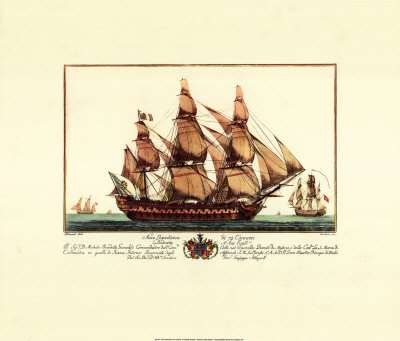
Today, the words "Pirate" or "Piracy" are spelled with an "I". In the Golden Age of Piracy, spelling was a haphazard kind of thing, and the word was often spelled with a "y". So there was a time when the word Pirate was spelled Pyrate, Pirate, Pyrat, or Pirat.
PIRATES - PRIVATEERS - BUCCANEERS
Although "pirate," "privateer," and "buccaneer" may often seem to be used interchangeably to describe a person, there are differences between the terms.
A pirate was someone who performed any unauthorized act of robbery on the high seas; a privateer was someone who was licensed by a government to attack enemy ships (technically during wartime only);
A buccaneer was initially someone who fought particularly the Spanish in the South America/Caribbean area (the Spanish Main). The term buccaneer later was used to describe both pirates and privateers. This collection of pirates and privateers known collectively as buccaneers formed somewhat of a fraternity called the Brethren of the Coast.
Piracy
Any robbery or other violent action, for private ends and without authorization by public authority, committed on the seas or in the air outside the normal jurisdiction of any state. Because piracy has been regarded as an offense against the law of nations, the public vessels of any state have been permitted to seize a pirate ship, to bring it into port, to try the crew (regardless of their nationality or domicile), and, if found guilty, to punish them and to confiscate the ship.
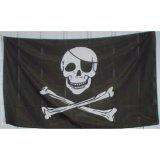
The Jolly Rodger was an actual flag that Pirates would fly.
The flag had many variation but the main body was usually always a scull and crossbones. There are many myths about the background of the Jolly Roger (also known as Captain Death among pirates.) The most popular myth is that plague ships would fly a black flag to warn others to stay away.
That flag became a black flag with a white cross that somehow mutated to a skull and crossbones on a back ground of black. The pirates began flying this flag as a way to keep prying eyes away. Eventually everyone caught onto the scheme.
Today, interesting enough.....you will always see boats on the lake flying a skull and crossbones. Many lake dwelling people have made it a fad and the scull and crossbones continues to be a big selling item even more-so today.
Pirate Ear rings
Did Pirates actually wear ear rings?
The answer is yes.
Real pirates were piercing their ears for a more practical purpose. It was believed that piercing the ears with such precious metals as silver and gold, improved one's eye sight. This was the main reason pirates performed such a ritual. It must also be noted that most other sea faring men also indulged in the practice.
While for years this was considered an old wives tale, today the art of acupuncture lends some credence to the practice of ear piercing. The ear lobe is an acupuncture point for several eye ailments. It is quite possible that the practice of ear piercing was brought to the west from the oriental trade routes.
Still another source says they used the earring as payment when they crossed over to the next world (when they died). Now this sounds logical considering the superstitious nature of mariners but it has one problem. A fellow pirate was quick to pull your payment from your ear lobe rather than send a perfectly good ear ring with you to Davy Jones.
Of course a final reason may simply be "fashion statement" on the wearers part. As pointed out by many people, pirates (at least the successful ones) were a colorful lot.
Davy Jones' Locker
Davy Jones' Locker is a nautical term that dates back to at least 1751 (first known written reference to the word). It is quite possible that the term existed orally among sailors before this date. Since it's first historical mention, the meaning of Davy Jones has changed very little.
Davy Jones was sailor slang for the evil spirits of the ocean. Davy's Locker or Davy Jones' Locker was the Deep ocean's bottom. To be sent to Davy's Locker was to perish at sea. To send someone to Davy Jones was to kill them.
The phrase Davy Jones appears in much of the popular nautical literature. There is no reason not to assume the term was common among sailors for many years. Other variations of Davy Jones' Locker are:
To be in Davy's Grip: To be close to death, or frightened.
To have the Davies or the Joneseys: To be frightened
To see you to Davy Jones: To threaten to kill some one
Awaken Davy or Awaken Davy Jones: To cause a storm