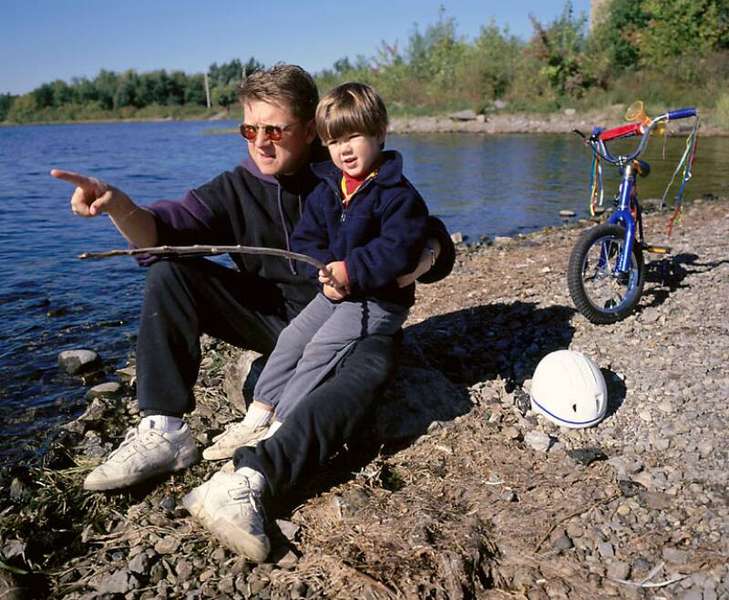
Father's Day is a day honoring fathers and celebrating fatherhood, paternal bonds, and the influence of fathers in society. It is celebrated on the third Sunday of June in 52 of the world's countries and on other days elsewhere. It complements Mother's Day, the celebration honoring mothers.
- - - - - - - - - - - - - - - - - - - - - - - - - - - - - - - - - - - - - - - - - - - - - - - - - - - - - - - - - - - - - - - - - - - - - - - - - - - - - - - - - - - - - - - - - - - - - - - - - - - - - - - -
Father's Day "Dates" vary from country to country.
• Third Sunday of June - Argentina, Bangladesh, Bulgaria,
Canada, Chile, China, Colombia,Costa Rica, Cuba,France,
Greece, Hong Kong, India, Japan, Malaysia, Malta,
Mauritius, Mexico, Netherlands, Pakistan, Peru, Philippines,
Puerto Rico, Ireland, Singapore, Slovakia, South Africa,
Sri Lanka, Trinidad and Tobago, Turkey, United Kingdom,
United States, Venezuela, Zimbabwe.
• In the United States it's the third Sunday in June.
• In New Zealand , Father's Day is celebrated on the first
Sunday of September.
• In Australia, Father's Day is celebrated on the first
Sunday of September.
• February 23 - Russia, Ukraine, Belarus
• March 19 - Bolivia, Honduras, Italy, Liechtenstein, Portugal,
Spain, Switzerland
• May 5 - Romania
• May 8 - South Korea (Parent's Day)
• First Day of June - Lithuania
• June 5 - Denmark
• Second Sunday of June - Astria, Belgium, Costa Rica, Ecuador
• June 17 - Guatemala, El Salvador
• June 23 - Nicaragua, Poland, Uganda
• July 7 - Vietnam
• Third Sunday of July - Uruguay
• Last Sunday of July - Dominican Republic
• First Sunday of September - Australia, New Zealand
• Second Sunday of August - Brazil
• August 8 - Taiwan
• Second Sunday of November - Estonia, Finland, Norway,
Sweden
• December 5 - Thailand
- - - - - - - - - - - - - - - - - - - - - - - - - - - - - - - - - - - - - - - - - - - - - - - - - - - - - - - - - - - - - - - - - - - - - - - - - - - - - - - - - - - - - - - - - - - - - - - - - - - - - - - -
History
Father's Day is a celebration inaugurated in the early twentieth century to complement Mother's Day in celebrating fatherhood and male parenting. It is also celebrated to honor and commemorate our fathers and forefathers. Father's Day is celebrated on a variety of dates worldwide and typically involves gift-giving, special dinners to fathers, and family-oriented activities. The first observance of Father's Day is believed to have been held on June 19, 1910 through the efforts of Sonora Dodd. Ms. Dodd is from Spokane, Washington.
Sonora Smart Dodd of Washington thought independently of the holiday one Sunday in 1909 while listening to a Mother's Day sermon at the Central Methodist Episcopal Church at Spokane. She wanted a celebration that honored fathers that were like her own father, William Smart. He was a Civil War veteran, his wife died when Sonora was 16 and he had to take care of all six children.
On June 19, 1910, she arranged a tribute for her father in Spokane. She had previously enlisted in 1909 the help of the Spokane Ministerial association, and young members of the YMCA went to church wearing roses: a red rose to honor a living father, and a white rose to honor a deceased one. Dodd travelled through the city in a closed carriage, carrying gifts to shut-in fathers. She was the first to solicit the idea of having an official Father's Day observance to honor all fathers.
A bill was introduced in 1913. In 1916 President Woodrow Wilson went to Spokane to speak in a Father's Day celebration and wanted to make it official, but the Congress resisted, fearing that it would be commercialized. US President Calvin Coolidge recommended in 1924 that the celebration was held, . and a national committee was formed in the 1930s by trade groups in order to legitimize the holiday. Other two bills to introduce the holiday were defeated. In 1957 Maine Senator Margaret Chase Smith wrote a proposal accusing the congress of ignoring fathers for 40 years while honoring mothers, thus "[singling] out just one of our own parents" In 1966 President Lyndon Johnson made a proclamation for third Sunday of June to be Father's Day, but it wasn't made an official national holiday until President Nixon made a proclamation in 1972.
• In addition to Father's Day, International Men's Day is celebrated in many countries on November 19 for men and boys who are not fathers.
- - - - - - - - - - - - - - - - - - - - - - - - - - - - - - - - - - - - - - - - - - - - - - - - - - - - - - - - - - - - - - - - - - - - - - - - - - - - - - - - - - - - - - - - - - - - - - - - - - - - - - - -
Commercialization
The Associated Men's Wear Retailers formed a National Father's Day Committee in New York City in the 1930s, which was renamed in 1938 to National Council for the Promotion of Father's Day and incorporated several other trade groups. This council had the goals of legitimizing the holiday in the mind of the people and managing the holiday as a commercial event in a more systematic way, in order to boost the sales during the holiday. This council always had the support of Dodd, who had no problem with the commercialization of the holiday and endorsed several promotions to increase the amount of gifts. In this aspect she can be considered the opposite of Anna Jarvis, who actively opposed all commercialization of Mother's Day.
The merchants recognized the tendency to parody and satirize the holiday, and used it to their benefit by mocking the holiday on the same advertisements where they promoted the gifts for fathers. People felt compelled to buy gifts even though they saw through the commercial façade, and the custom of giving gifts on that day became progressively more accepted. By 1937 the Father's Day Council calculated that only one father in six had received a present on that day. However, by the 1980s, the Council proclaimed that they had achieved their goal: the one-day event had become a three-week commercial event, a "second Christmas". Its executive director explained back in 1949 that, without the coordinated efforts of the Council and of the groups supporting it, the holiday would have disappeared.
- - - - - - - - - - - - - - - - - - - - - - - - - - - - - - - - - - - - - - - - - - - - - - - - - - - - - - - - - - - - - - - - - - - - - - - - - - - - - - - - - - - - - - - - - - - - - - - - - - - - - - - -
Spelling
Although the name of the event is usually understood as a plural possessive (i.e. "day belonging to fathers"), which would under normal English punctuation guidelines be spelled "Fathers' Day", the most common spelling is "Father's Day", as if it were a singular possessive (i.e. "day belonging to Father"). Dodd used the "Fathers' Day" spelling on her original petition for the holiday, but the spelling "Father's Day" was already used in 1913 when a bill was introduced to the US Congress as the first attempt to establish the holiday, and it was still spelled the same way when its creator was commended in 2008 by the U.S. Congress.
- - - - - - - - - - - - - - - - - - - - - - - - - - - - - - - - - - - - - - - - - - - - - - - - - - - - - - - - - - - - - - - - - - - - - - - - - - - - - - - - - - - - - - - - - - - - - - - - - - - - - - - -
See also:
References
Related Outside Links:
- - - - - - - - - - - - - - - - - - - - - - - - - - - - - - - - - - - - - - - - - - - - - - - - - - - - - - - - - - - - - - - - - - - - - - - - - - - - - - - - - - - - - - - - - - - - - - - - - - - - - - - -