Time to get Grilling on all these oliday's!
It doesn't have to be summer time to enjoy the great flavors of the grill.
Our Grilling & BBQ section is just full of great information so get yourself ready for a Grilling Day!
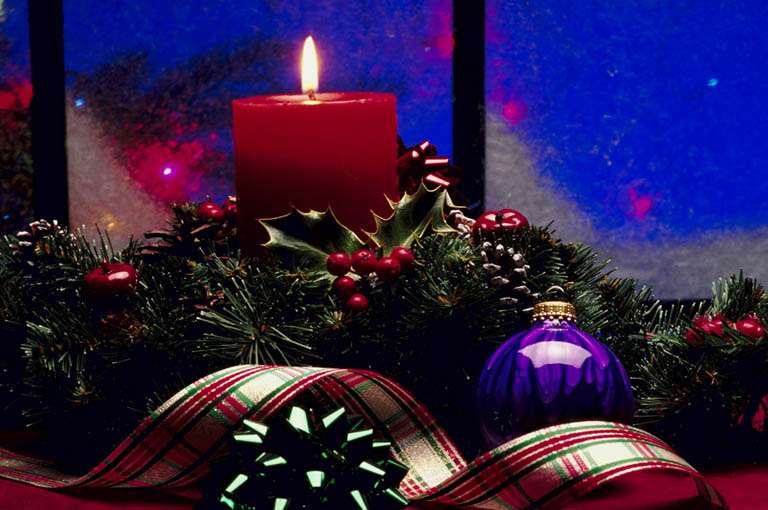
Definition of a Candle
A candle is a light source that usually has an internal wick rising through the center of a column of solid fuel.
Prior to the mid 19th century, candle were frequently made from tallow (a byproduct of beef-fat rendering). The fuel now is nearly always some form of wax, with paraffin wax being the most common. Candles made from gel, soy, beeswax, and vegetable products are also available.
A candle manufacturer is traditionally known as a chandler. Various devices have been invented to secure candles into place, from simple tabletop candle holders, to elaborate chandeliers.
Prior to the candle being ignited, the wick is saturated with the fuel in its solid form. The heat of the match or other flame being used to light the candle first melts and then vaporizes a small amount of the fuel. Once vaporized, the fuel combines with oxygen in the atmosphere to form a flame. This flame then provides sufficient heat to keep the candle burning via a self-sustaining chain of events: the heat of the flame melts the top of the mass of solid fuel, the liquified fuel then moves upward through the wick via capillary action, and the liquified fuel is then vaporized to burn within the candle's flame.
The burning of the fuel takes place in several distinct regions (as evidenced by the various colors that can be seen within the candle's flame). Within the bluer, hotter regions, hydrogen is being separated from the fuel and burned to form water vapor. The brighter, yellower part of the flame is the remaining carbon being oxidized to form carbon dioxide.
As the mass of the solid fuel is melted and consumed, the candle grows shorter. Portions of the wick that are not evaporating the liquid fuel are, ideally, consumed in the flame, limiting the exposed length of the wick and keeping the temperature and rate of fuel consumption even. Some wicks require manual trimming with scissors or a wick trimmer for even burning.
________________________________________________
Christmas Candle Facts
- Candles are a traditional feature of Christmas ceremonies (and in fact many Christian rituals), especially on Christmas Eve.
- Candles have also been used to decorate Christmas trees.
- Candles are used to decorate the Christmas dinner table.
- Candles are used on Advent wreaths.
- Candles are lit to mark the Twelve Days of Christmas.
- The lighting of fires (such as Yule logs) in mid-Winter, dates back to pre-Christian times and was used to mark the Winter Solistice, and the eventual triumph of light over the dark Winter.
More Candle Facts
- The candle was developed independently in many countries.
- In Rome, around the first century, candles were made out of tallow and the pith of rushes.
- The Egyptians and Cretans made the candle from beeswax, as early as 3000 BC.
- The early candle was made from various forms of natural fat, tallow, and wax.
- In the 18th century, spermaceti, oil produced by the sperm whale, was used to produce a superior candle.
- Late in the 18th century, colza oil and rapeseed oil came into use as much cheaper substitutes.
- Paraffin was first distilled in 1830, and revolutionized candle-making, as it was an inexpensive material which produced a high-quality, odorless candle that burned reasonably cleanly.
- In Christianity the candle is commonly used in worship both for decoration and ambiance, and as symbols that represent the light of God or, specifically, the light of Christ. The candle is often placed on the altar. A Votive candle may be lit as an accompaniment to prayer.
- With the fairly consistent and measurable burning of a candle, a common use was to tell the time. The candle designed for this purpose might have time measurements, usually in hours, marked along the wax.
________________________________________________