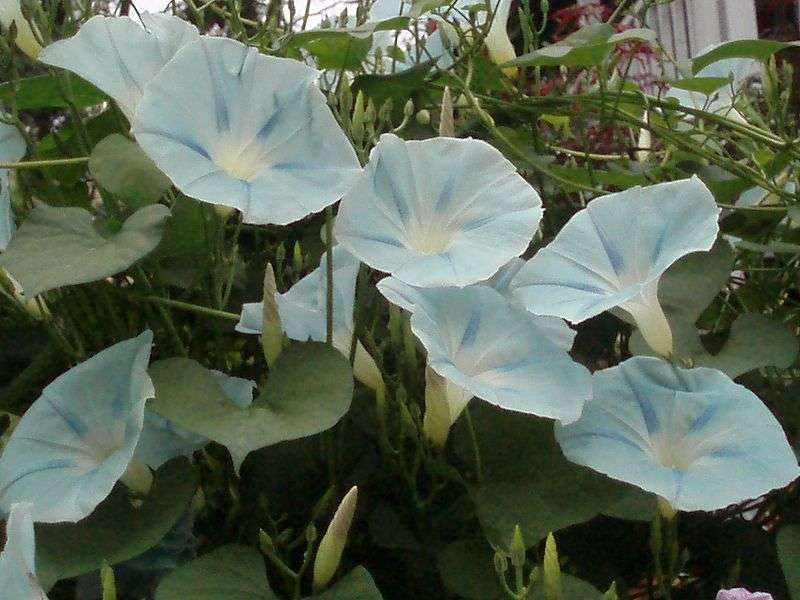
What Month does the Morning Glory represent?
The Morning Glory flower represents the birth month of September.
Birth Flowers
Just as each month has its own gemstone, each month also has its own traditional birth flower appropriate for the month and season.
Are there any holidays related?
Yes! Plant a Flower Day is March 9th!
__________________________________________________
Morning glory is a common name for over 1,000 species of flowering plants in the family Convolvulaceae, belonging to the following genera:
Calystegia
Convolvulus
Ipomoea
Merremia
Rivea
As the name implies, morning glory flowers, which are funnel-shaped, open in the morning, allowing them to be pollinated by hummingbirds, butterflies, bees, and other daytime insects and birds as well as Hawkmoth at dusk for longer blooming variants. The flower typically lasts for a single morning and dies in the afternoon. New flowers bloom each day. The flowers usually start to fade a couple of hours before the petals start showing visible curling. They prefer full sun throughout the day and mesic soils. In cultivation, most are treated as perennial plants in tropical areas and as annual plants in colder climates, but some species tolerate winter cold. Morning glories are a close relative of Moon flowers which open at night to be pollinated by moths.
Morning glory is also called asagao (in Japanese, a compound of ? asa "morning" and ? kao "face"). A rare brownish-coloured variant known as Danjuro is very popular. It was first known in China for its medicinal uses, due to the laxative properties of its seeds. It was introduced to the Japanese in the 9th century, and they were first to cultivate it as an ornament. During the Edo Period, it became a very popular ornamental flower. Aztec priests in Mexico were also known to use the plant's hallucinogenic properties. (see Rivea corymbosa).
Ancient Mesoamerican civilizations used the morning glory species Ipomoea alba to convert the latex from the Castilla elastica tree and also the guayule plant to produce bouncing rubber balls. The sulfur in the morning glory's juice served to vulcanize the rubber, a process pre-dating Charles Goodyear's discovery by at least 3,000 years.
Because of their fast growth, twining habit, attractive flowers, and tolerance for poor, dry soils, some morning glories are excellent vines for creating summer shade on building walls when trellised, thus keeping the building cooler and reducing heating and cooling costs.
Popular varieties in contemporary western cultivation include the "Heavenly Blue", the moonflower, the cypress vine, and the cardinal climber. The cypress vine is a hybrid, with the cardinal climber as one parent.
In some places such as Australian bushland morning glories develop thick roots and tend to grow in dense thickets. They can quickly spread by way of long creeping stems. By crowding out, blanketing and smothering other plants, morning glory has turned into a serious invasive weed problem.