Just as each month has its own gemstone/birthstones, did you know that each month also has its own traditional birth flower appropriate for the month and season. Take a look at a complete list of Birth Flowers and each month they represent.
Flower symbolism is common in many cultures, and can be complex. In China, certain flowers symbolize seasons: white plum blossoms represent winter, peach and cherry blossoms represent spring, lotus represents summer, and chrysanthemums the fall.
Belcher, Betty (1993). Creative flower arranging: floral design for home and flower show. Timber Press. pp. 16–17. ISBN 978-0-88192-247-9.
Enumerated below are flowers of the month and their special meanings which are associated with specific months. It would be a helpful guide for gifting flowers for someone’s birthday. The language of flowers was introduced to England in the early 18th century by Mary Wortley, Lady Montague, whose husband was Ambassador to Turkey.
Some scholars believe that the name "carnation" comes from "coronation" or "corone" (flower garlands), as it was one of the flowers used in Greek ceremonial crowns. Carnations are often worn on special occasions, especially Mother's Day and weddings.
January Explanation: Though this cold and gloomy season seems like an unlikely time for flowers to bloom, but nature has designed flowers which love the extreme weather. The flower associated with the month is Carnation and is said to symbolise love, fascination and distinction. Carnation, which is also commonly called Gillyflower, is found in a number of colors from pink to purple-red.
Most Viola species are small perennial plants, some are annual plants, and a few are small shrubs. A number of species are grown for their ornamental flowers in borders and rock gardens; the garden pansy in particular is an extensively used spring and autumn / winter bedding & pot plant.
February Explanation: This month is associated with St. Valentine’s Day and red roses. However, the flower for the month is Violet. The flower symbolises faithfulness, humility and chastity. Gifting violets in the Victorian era conveyed the message’ I’ll always be true’. The flower is found in shades of blue, mauve as well as yellow and cream.
The first flower to lead the way through the cold snowy ground to scream out "It's Spring." In some countries the yellow is associated with Easter. Brilliant yellow blooms of all kinds symbolize friendship, a new beginning, and happiness.
March Explanation: This month is synonymous with the onset of spring (in the Northern Hemisphere). Accordingly the flower associated with this month is Daffodil also known as Jonquil or Narcissus. The colours of the bloom include white, yellow and orange. A gift of these flowers conveys the hidden meaning of friendship and happiness.
It is thought that the name "daisy" is a corruption of "day's eye", because the whole head closes at night and opens in the morning. Chaucer called it "eye of the day". The species is widely naturalized in North America, where it is considered an invasive weed.
April Explanation: This month is associated with Sweet pea flower which bloom in a wide range of soft colors as well as two tone colours. It is said to symbolise pleasure or good-bye. In the Victorian era, these flowers formed a part of the bouquet which was sent to someone to convey gratefulness.
Convallaria majalis is a popular garden plant, grown for the scented flowers. This woodland plant is native throughout the cool temperate Northern Hemisphere in Asia and Europe and a limited native population in Eastern USA.
May Explanation: The month of May is associated with the Lily of the valley flower. It is generally white in colour. The flower conveys sweetness and humility. In the Victorian era, it was gifted to convey the romantic message ‘you have made my life complete’.
Roses are one of the most popular garden shrubs, as well as the most popular and commonly sold florists' flowers. In addition to their great economic importance as a florists crop, roses are also of great value to the perfume industry. see National Rose Month
June Explanation: Rose is the flower of this month. Though roses are available in many colors from red to pink to white to yellow, all with their own special meanings, the underlying message the flowers convey is that of love and passion.
Each month has a flower that symbolizes the month of somebody's birth. Every month has a flower that is sometimes referred to as a Birth Month Flower. Not to be confused with your birth "DATE" flower.
Flowers by month is a term describing flowers related to a recipient's birth month, and in general flowers associated with particular months of the year. It is one of a class of specialized categorizations offered by florists.
In a cultural sense, flower characteristics such as appearance, color, and scent, have relevance as gifts. It is believed that it were the Romans who started celebrating birth and birthdays using flowers. Seasonal flowers were used not just for decoration, but also taken as gifts and therefore can probably be credited with the tradition of birth flowers.[citation needed] Some have been inspired by this tradition to create lists that associate a birthday flower with each of the days in a year.
Water lilies are plants in the family Nymphaeaceae that live in freshwater areas in temperate and tropical climates around the world. The family Nyhmpaeaceae contains 8 genera. There are about 70 species of water lilies around the world.
July Explanation: Larkspur is the flower for July. With its simple form, feelings of open heart and ardent attachment are attributed to it.
Poppies have long been used as a symbol of both sleep and death: sleep because of the opium extracted from them, and death because of their (commonly) blood-red color. In Greco-Roman myths, poppies were used as offerings to the dead.Poppies are used as emblems on tombstones to symbolize eternal sleep.
August Explanation: The flower for this month is the Gladiolus. It blooms in a variety of colours like red, pink, white, yellow and orange. It stands for sincerity and symbolises strength of character.
As the name implies, morning glory flowers, which are funnel-shaped, open in the morning, allowing them to be pollinated by hummingbirds, butterflies, bees, and other daytime insects and birds as well as Hawkmoth at dusk for longer blooming variants.
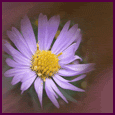
September Explanation: Aster or September flower is the flower for this month. It is found in a number of colours – pink, red, white, lilac and mauve. The name of the flower which looks like a star is derived from the Greek word for star. The flower symbolises love, faith, wisdom & colour.
The name Calendula stems from the Latin kalendae, meaning first day of the month, presumably because pot marigolds are in bloom at the start of most months of the year. Marigolds are considered by many gardening experts as one of the most versatile flowers to grow in a garden, especially since it is easy to grow.
October Explanation: Marigold or Calendula is the flower associated with October. For the Hindus, the month of October is associated with festivals like Dusshera and Diwali and Marigold, an auspicious flower is part of religious ceremonies. However, in the English culture, marigold stands for sorrow and sympathy.
Modern chrysanthemums are much more showy than their wild relatives. The flowers occur in various forms, and can be daisy-like, decorative, pompons or buttons. This genus contains many hybrids and thousands of cultivars developed for horticultural purposes.
National Chrysanthemum Day is July 18.
November Explanation: Chrysanthemum, which stands for cheerfulness and love, is associated with the month of November. According to Feng Shui, Chrysanthemums brings happiness and laughter in the house.
In many western cultures, holly is a traditional Christmas decoration, used especially in wreaths. Many of the hollies are highly decorative, and are widely used as ornamental plants in gardens and parks.
December Explanation: Narcissus, the flower associated with December, symbolises respect, modesty and faithfulness


































 Carnation -