"He was a bold man that first ate an oyster"
Jonathan Swift is quoted as having said, "He was a bold man that first ate an oyster", but evidence of oyster consumption goes back into prehistory, evidenced by oyster middens found worldwide. Oysters were an important food source in all coastal areas where they could be found, and oyster fisheries were an important industry where they were plentiful. Overfishing and pressure from diseases and pollution have sharply reduced supplies, but they remain a popular treat celebrated in oyster festivals in many cities and towns.
Oysters are sometimes cited as an aphrodisiac
It is disputed whether this is true. "A team of American and Italian researchers analyzed bivalves and found they were rich in rare amino acids that trigger increased levels of sex hormones. Also oysters have a high zinc content, a mineral that aids in the production of testosterone. Alternatively, the oyster's erotic reputation may only be due to its soft, moist texture and appearance." Most people swear by it and continue to eat oysters to up the libido.
Health benefits of eating oysters
Oysters, especially 'wild', are excellent sources of the several minerals, including zinc and selenium, which are often low in the modern diet. They also tend to be excellent real food sources of Vitamin D. Oysters are considered the healthiest when eaten raw on the half shell.
Oysters are low in food energy; one dozen raw oysters contain approximately 110 kilocalories (460 kJ), and are rich in zinc, iron, calcium, and vitamin A.
Preparation and storage
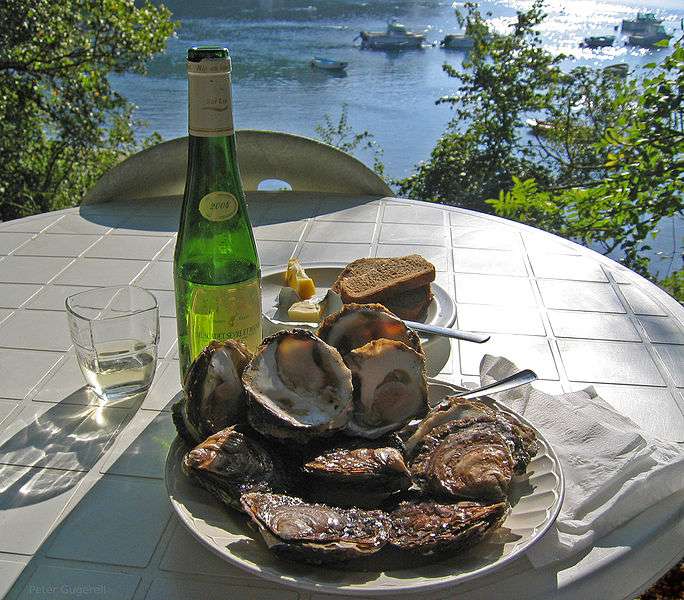
"Fried oyster with egg and flour is a common dish in Singapore. Oysters can be eaten on the half shell, raw, smoked, boiled, baked, fried, roasted, stewed, canned, pickled, steamed, broiled or used in a variety of drinks. Preparation widely varies. It can be as simple as opening the shell and eating the contents, including juice. Butter and salt are often added. In the case of oysters Rockefeller, preparation can be very elaborate. They are sometimes served on edible seaweed, such as brown algae.
Unlike most shellfish, oysters can have a fairly long shelf-life: up to two weeks; however, their (decreasingly pleasing) taste reflects their age. Oysters should be refrigerated out of water, not frozen and in 100% humidity. Oysters stored in water under refrigeration will open, consume available oxygen and die. Care should be taken when consuming oysters. Purists insist on eating them raw, with no dressing save perhaps lemon juice, vinegar (most commonly shallot vinegar), or cocktail sauce. Upscale restaurants pair raw oysters with a home-made Mignonette sauce, which consists primarily of fresh chopped shallot, mixed peppercorn, dry white wine and lemon juice or sherry vinegar. Like fine wine, raw oysters have complex flavors that vary greatly among varieties and regions: sweet, salty, earthy, or even melon. The texture is soft and fleshy, but crisp on the palate. North American varieties include: Kumamoto and Yaquina Bay from Washington State, Malpeque from Prince Edward Island, Canada, Blue Point from Long Island, New York, and Cape May oysters from New Jersey. Salinity, mineral, and nutrient variations in the water that nurtures them influence their flavor profile.
Non-local oysters are generally expensive. In the United States, oysters are most often cooked, but there is also a high demand for raw oysters on the half-shell (shooters) at oyster bars. Canned smoked oysters are also widely available as preserves with a long shelf life. Raw oysters are still found in many temperate areas bordering a sea or ocean. Oysters are commonly eaten raw in France in bars and as a 'bar fast food' but the home use tends to be mixed with a large usage in cooking - steamed or in paella or soups.
It was once assumed that oysters were only safe to eat in months with the letter ‘r’ in their English and French names. This is a myth whose basis in truth is that in the northern hemisphere oysters are much more likely to spoil in May, June, July, and August.
Oysters must be eaten alive, or cooked alive. The shells of live oysters are normally tightly closed or snap shut given a slight tap. If the shell is open, the oyster is dead, and cannot be eaten safely.
Cooking oysters in the shell kills the oysters and causes them to open by themselves. Oysters that don't open were dead before cooking and are unsafe.
Oysters can contain harmful bacteria. Oysters are filter feeders and will naturally concentrate anything present in the surrounding water. Oysters from the Gulf Coast of the United States, for example, contain high bacterial loads of human pathogens in the warm months, most notably Vibrio vulnificus and Vibrio parahaemolyticus. In these cases, the main danger is for immuno-compromised individuals, who are unable to fight off infection and can succumb to septicemia, leading to death. Vibrio vulnificus is the most deadly seafood-borne pathogen, with a higher case-to-death ratio than even Salmonella enterica and Escherichia coli.
-------------------------------------------------------------------------------------------------------------------------------------------------------
Recomended Product:
(ISBN 0865473358) is a book by M.F.K. Fisher that deals in the history, preparation and eating of oysters. The work was first published in the United States in 1941 and has been in print ever since. Thin, poetical, and whimsical, it is, perhaps, the most famous book about oysters ever written.
Resources: