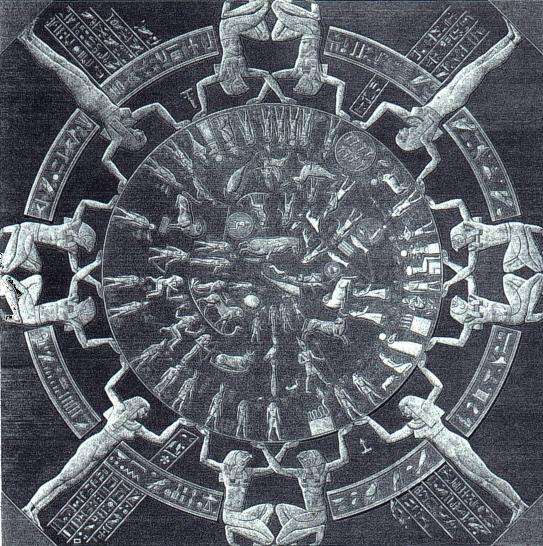
In astronomy, the zodiac (Greek: ζῳδιακός, zōdiakos) is the ring of constellations that lines the ecliptic, which is the apparent path of the Sun across the sky over the course of the year.
- - - - - - - - - - - - - - - - - - - - - - - - - - - - - - - - - - - - - - - - - - - - - - - - - - - - - - - - - - - - - - - - - - - - - - - - - - - - - - - - - - - - - - - - - - - - - - - - - - - - - - - -
ABOUT
1 - The Moon and planets also lie within the ecliptic, and so are also within the constellations of the zodiac. In astrology, the zodiac denotes those signs that divide the ecliptic into twelve equal zones of celestial longitude. As such, the zodiac is a celestial coordinate system, to be more precise, an ecliptic coordinate system, taking the ecliptic as the origin of latitude, and the position of the sun at vernal equinox as the origin of longitude.
- - - - - - - - - - - - - - - - - - - - - - - - - - - - - - - - - - - - - - - - - - - - - - - - - - - - - - - - - - - - - - - - - - - - - - - - - - - - - - - - - - - - - - - - - - - - - - - - - - - - - - - -
2 - It is know to have been in use by the Roman ers, based on concepts inherited by Hellenistic astronomy from Babylonian astronomy of the Chaldean period (mid-1st millennium BC), which, in turn, derived from an earlier system of lists of stars along the ecliptic. The construction of the zodiac is described in Ptolemy's Almagest (2nd century AD). The term zodiac may also refer to the region of the celestial sphere encompassing the paths of the planets corresponding to the band of about eight arc degrees above and below the ecliptic. The zodiac of a given planet is the band that contains the path of that particular body; e.g., the "zodiac of the Moon" is the band of five degrees above and below the ecliptic. By extension, the "zodiac of the comets" may refer to the band encompassing most short-period comets
- - - - - - - - - - - - - - - - - - - - - - - - - - - - - - - - - - - - - - - - - - - - - - - - - - - - - - - - - - - - - - - - - - - - - - - - - - - - - - - - - - - - - - - - - - - - - - - - - - - - - - - -
3 - The term zodiac derives from Latin zōdiacus, which in its turn comes from the Greek ζῳδιακὸς κύκλος (zōdiakos kuklos), meaning circle of animals, derived from ζώδιον (zōdion), the diminutive of ζῶον (zōon) animal. The name is motivated by the fact that half of the signs of the classical Greek zodiac are represented as animals as well as two mythological hybrids.
- - - - - - - - - - - - - - - - - - - - - - - - - - - - - - - - - - - - - - - - - - - - - - - - - - - - - - - - - - - - - - - - - - - - - - - - - - - - - - - - - - - - - - - - - - - - - - - - - - - - - - - -
4 - Although the zodiac remains the basis of the ecliptic coordinate system in use in astronomy besides the equatorial one, the term and the names of the twelve signs are today mostly associated with
- - - - - - - - - - - - - - - - - - - - - - - - - - - - - - - - - - - - - - - - - - - - - - - - - - - - - - - - - - - - - - - - - - - - - - - - - - - - - - - - - - - - - - - - - - - - - - - - - - - - - - - -
History
The division of the ecliptic into the zodiacal signs originates in Babylonian ("Chaldean") astronomy during the first half of the 1st millennium BC, likely during Median/"Neo-Babylonian" times (7th century BC), continuing earlier (Bronze Age) systems of lists of stars. Babylonian astronomers at some point during the early 1st millennium BC divided the ecliptic into twelve equal zones of celestial longitude to create the first known celestial coordinate system: a coordinate system that boasts some advantages over modern systems (such as equatorial coordinate system or ecliptic coordinate system). The Babylonian calendar as it stood in the 7th century BC assigns each month a constellation, beginning with the position of the Sun at vernal equinox, which, at the time, was the Aries constellation ("Age of Aries"), for which reason the first astrological sign is still called "Aries" even after the vernal equinox has moved away from the Aries constellation due to the slow precession of the Earth's orbit around the Sun. A scientific analysis of the constellations suggests Aries' was located at the vernal equinox at the time of the Bronze Age (~2700 BC), thereby suggesting an earlier establishment of the constellations.
The transmission of the zodiac system to Hindu astrology predated widespread awareness of the precession of the equinoxes, and the Hindu system ended up using a sidereal coordinate system (as opposed to the Tropical System followed by the Greeks), which resulted in the European and the Hindu zodiacs, even though sharing the same origin in Hellenistic astrology, gradually moving apart over two millennia that have passed since. The Sanskrit names of the signs are direct translations of the Greek names (dhanus meaning "bow" rather than "archer", and kumbha meaning "water-pitcher" rather than "water-carrier").
Particularly important in the development of Western horoscopic astrology was the astrologer and astronomer Ptolemy, whose work Tetrabiblos laid the basis of the Western astrological tradition. Under the Greeks, and Ptolemy in particular, the planets, Houses, and signs of the zodiac were rationalized and their function set down in a way that has changed little to the present day. Ptolemy lived in the 2nd century AD, three centuries after the discovery of the precession of the equinoxes by Hipparchus around 130 BC, but he ignored the problem, by dropping the concept of a fixed celestial sphere and adopting what is referred to as a tropical coordinate system instead.
The High Middle Ages saw a revival of Greco-Roman magic, first in Kabbalism and later continued in Renaissance magic. This included magical uses of the zodiac, as found, e.g., in the Sefer Raziel HaMalakh.
The zodiacal signs remain in use as the basis of an ecliptic coordinate system, though modern astronomers have tended to use an equatorial coordinate system since Early Modern times. One can see that the use of the sidereal coordinate remained in use throughout the medieval period, e.g., in "de mensura astrolabii liber" by Hermannus Contractus, who gives the locations of stars in stereographic projection for the construction of an astrolabe. He gives the zodiac coordinate of Antares as 14. Scorpius, equalling a J2000.0 ecliptic longitude of 224° (the 14th degree from the beginning of Scorpius at 210°).
Some authors have drawn parallels between the Babylonian zodiac and the Bible. 19th century theologian E. W. Bullinger interpreted the creatures appearing in the books of Ezekiel and Revelation as the middle signs of the four quarters of the Zodiac, with the Lion as Leo, the Bull is Taurus, the Man representing Aquarius and the Eagle standing in Some authors have linked the twelve tribes of Israel with the twelve signs. Martin and others have argued that the arrangement of the tribes around the Tabernacle (reported in the Book of Numbers) corresponded to the order of the Zodiac, with Judah, Reuben, Ephraim and Dan representing the middle signs of Leo, Aquarius, Taurus and Scorpio, respectively. Such connections were taken up by Thomas Mann, who in his novel Joseph and His Brothers, attributes characteristics of a sign of the zodiac to each tribe in his rendition of the Blessing of Jacob.
- - - - - - - - - - - - - - - - - - - - - - - - - - - - - - - - - - - - - - - - - - - - - - - - - - - - - - - - - - - - - - - - - - - - - - - - - - - - - - - - - - - - - - - - - - - - - - - - - - - - - - - -
The Twelve Signs of the Zodiac:
What follows is a list of the twelve signs of the zodiac (with the ecliptic longitudes of their first points), where 0° Aries is understood as the vernal equinox, with their Latin, Greek, Sanskrit, and Babylonian names (but note that the Sanskrit and the Babylonian name equivalents denote the constellations only, not the tropical zodiac signs). Also, the "English translation" is not usually used by English speakers. The Latin names are standard English usage.
- - - - - - - - - - - - - - - - - - - - - - - - - - - - - - - - - - - - - - - - - - - - - - - - - - - - - - - - - - - - - - - - - - - - - - - - - - - - - - - - - - - - - - - - - - - - - - - - - - - - - - - -
External Links:
- - - - - - - - - - - - - - - - - - - - - - - - - - - - - - - - - - - - - - - - - - - - - - - - - - - - - - - - - - - - - - - - - - - - - - - - - - - - - - - - - - - - - - - - - - - - - - - - - - - - - - - -