"Myths are public dreams, dreams are private myths." Joseph Campbell
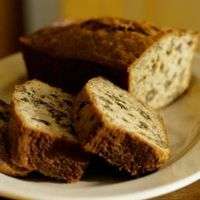
National Banana Bread Day - always February 23
Banana bread is a type of bread that contains mashed yellow bananas. Banana bread is usually a quick bread: a sweet, cake-like bread which typically uses baking soda as the leavening agent instead of yeast; however, there are some banana bread recipes that are traditional-style yeast breads. ......
Fun Food Facts: "Banana bread first became a standard feature of American cookbooks with the popularization of baking soda and baking powder in the 1930s, and appears in Pillsbury's 1933 Balanced Recipes cookbook. The origin of the first banana bread recipe is unknown, though some speculate it was originated in the 18th century by housewives experimenting with pearlash? The home baking revival of the 1960s and the simplicity of its recipe led to an explosion in banana bread's popularity. The cookbooks of the 1960s added to its popularity because they commonly listed multiple variations of bread that added fruits, nuts, and even chocolate chips."
Tansy (Tanacetum vulgare) is a perennial, herbaceous flowering plant of the aster family that is native to temperate Europe and Asia. It has been introduced to other parts of the world and, in some areas, has become invasive. It is also known as Common Tansy, Bitter Buttons, Cow Bitter, Mugwort, or Golden Buttons.
• Click photo for larger image • (not to be confused with the Flower-of-the-month)
Ethnomedical use: Wikipedia says Tansy has been used as a medicinal herb for years. "Irish folklore of the mid-1800s suggests bathing in a solution of Tansy and salt as a cure for joint pain. Bitter tea made with the blossoms of T. vulgare has been effectively used for centuries as an anthelmintic (vermifuge). Tansy cakes were traditionally served during Lent because of a superstition that eating fish during Lent caused intestinal worms. Note that only T.tansys is used in medicinal preparations; all species of tansy are toxic, and an overdose can be fatal. The dried flowering herb of Tanacetum is used ethnomedically to treat migraine, neuralgia, and rheumatism, and as an antihelminthic, in conjunction with a competent herbalist to circumvent any possible toxicity."
"Tansy is also used as a companion plant, especially with cucurbits like cucumbers and squash, or with roses or various berries. It is thought to repel ants, cucumber beetles, Japanese beetles, squash bugs, and some kinds of flying insects, among others."
Is Your Birthday February 23?(Pisces / February 20 - March 20 / Birthstone - Amethyst)
If it is, you share your Birthday with: Sparky Anderson, Drew Barrymore, James Blunt, Julius Erving and Vijay Singh and Pope Paul II (d. 1471)?
It is common for people to receive gifts on their birthdays or surprise birthday party.
"The popular gifts include toys, books, jewellery, clothes, flowers, technical devices, etc. However, sometimes it is expected of the person celebrating their birthday to treat their party guests instead; this varies depending on the local culture and may involve party gifts or other
gestures, for example inviting to the restaurant or bar (some of them offer special birthday programs), arranging party at home, or at work. The origin of the birthday gift giving originates from the gift giving celebration of Christmas.
1918 - First victory of Red Army over the Kaiser's German troops near Narva and Pskov. In honor of this victory, the date is celebrated from 1923 onward as "Red Army Day"; it is renamed Defender of the Fatherland Day after the fall of the Soviet Union in 1991, and is colloquially known as "Men's Day".
Polycarp of Smyrna (Catholic Church) - "Polycarp occupies an important place in the history of the early Christian Church. He is among the earliest Christians whose writings survive. It is probable that he knew John the Apostle, the disciple of Jesus. He was an elder of an important congregation in an area where the apostles laboured. And he is from an era whose orthodoxy is widely accepted by Orthodox Churches, Oriental Churches, Seventh Day Church of God groups, Protestants and Catholics alike. All of this makes his writings of great interest."
Serenus the Gardener - "According to legend, he was born in Greece, emigrated to Sirmium in present-day Sremska Mitrovica, and was known for his skill at gardening. He rebuked the wife of an imperial guard for walking in his garden and she told her husband, who reported him to the Emperor Maximian. The governor found Serenus innocent of insulting the guard's wife, but had him beheaded anyway when he refused to sacrifice to the Roman gods. Parts of his story are probably fictitious. However, Paul Burns writes that “there may possibly be some historical basis to the...story...”"