National Chocolate Souffle Day - Always February 28
A soufflé is a light, fluffy, baked cake made with egg yolks and beaten egg whites combined with various other ingredients and served as a savory main dish or sweetened as a dessert. The word soufflé is the past participle of the French verb souffler which means "to blow up" or more loosely "puff up" — an apt description of what happens to this combination of custard and egg whites.
Every soufflé is made from 2 basic components: 1.a French Creme patissiere base/flavored cream sauce or purée 2.Egg whites beaten to a soft peak meringue. The base provides the flavour and the whites provide the "lift". Foods commonly used for the base in a soufflé include jam, fruits, berries, chocolate, banana and lemon (the last three are used for desserts, often with a good deal of sugar). When it comes out of the oven, a soufflé should be puffed up and fluffy, and will generally fall after 5 or 10 minutes (as risen dough does).
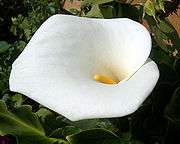
"Zantedeschia is a genus of herbaceous flowering plants in the family Araceae, native to southern Africa from South Africa north to Malawi. The name of the genus was given as a tribute to Italian botanist Giovanni Zantedeschi (1773-1846) by the German botanist Kurt Sprengel (1766-1833).
"Common names include Arum lily for Z. aethiopica, calla, and calla lily for Z. elliottiana and Z. rehmannii although it is neither a true lily (Liliaceae), nor Arum or Calla (related genera in Araceae). It is also often erroneously spelled as "cala lily". It has often been used in many paintings, and is visible in many of Diego Rivera's works of art (see The Flower Vendor, amongst others).
The Zantedeschia are rhizomatous herbaceous perennial plants growing to 1-2.5 m tall with leaves 15-45 cm long. The inflorescence is a showy white, yellow or pink spathe shaped like a funnel with a yellow, central, finger-like spadix."
The Zantedeschia species are poisonous due to the presence of calcium oxalate. "All parts of the plant are toxic, and produce irritation and swelling of the mouth and throat, acute vomiting and diarrhea." However leaves are sometimes cooked and eaten."