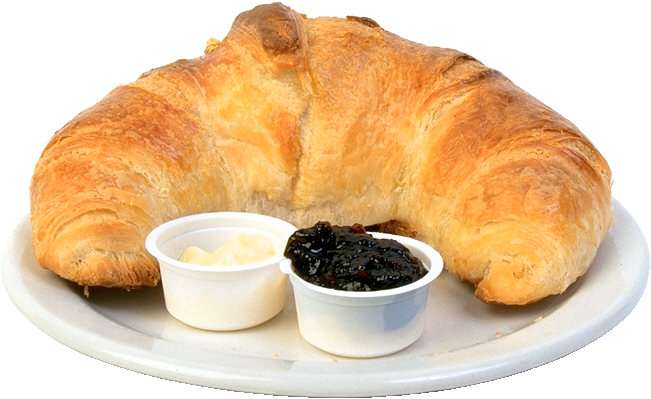
National Croissant Day (January 30) US Observance / Food Holiday
"A croissant is a buttery flaky pastry, named for its distinctive crescent shape. It is also sometimes called a crescent or crescent roll. Croissants are made of a leavened variant of puff pastry. The yeast dough is layered with butter, rolled and folded several times in succession, then rolled into a sheet, a technique called laminating."
"Crescent-shaped breads have been made since the Middle Ages, and crescent-shaped cakes (imitating the often-worshiped Moon) possibly since classical times. Making croissant by hand requires skill and patience; a batch of croissants can take several days to complete. However, the development of factory-made, frozen, pre-formed but unbaked dough has made them into a fast food which can be freshly baked by unskilled labor."
almond filling. In the United States, sweet fillings or toppings are common, and warm croissants may be filled with ham and cheese or feta cheese and spinach. In the Levant, croissants are sold plain or filled with chocolate, cheese, almonds, or zaatar. In Germany, croissants are sometimes filled with Nutella or persipan; in Southern Germany there also is a popular variety of a croissant glazed with lye ("Laugencroissant"). In Switzerland the croissant is typically called a Gipfeli which typically has a crisper crust and is less buttery than the French style croissant. In some Latin American countries, croissants are commonly served alongside coffee as a breakfast or merienda. These croissant are referred to as medialunas ("half moons") and are typically coated with a sweet glaze ("de manteca", made with butter). Another variant is a medialuna "de grasa" ("of lard"), which is not sweet."
We celebrate "National Croissant Day" along with other bread holidays:
• Bread Machine Baking Month falls in the month of January.
• National Wheat Bread Month also falls in the month of January.
- - - - - - - - - - - - - - - - - - - - - - - - - - - - - - - - - - - - - - - - - - - - - - - - - - - - - - - - - - - - - - - - - - - - - - - - - - - - - - - - - - - - - - - - - - - - - - - - - - - - -
Bloody Sunday (January 30) Northern Ireland
•
- - - - - - - - - - - - - - - - - - - - - - - - - - - - - - - - - - - - - - - - - - - - - - - - - - - - - - - - - - - - - - - - - - - - - - - - - - - - - - - - - - - - - - - - - - - - - - - - - - - - -
- - - - - - - - - - - - - - - - - - - - - - - - - - - - - - - - - - - - - - - - - - - - - - - - - - - - - - - - - - - - - - - - - - - - - - - - - - - - - - - - - - - - - - - - - - - - - - - - - - - - -
Other noted Observances for January 30
• St. Mutien-Marie Wiaux (+1917)
• St. Hippolytus
• St. Hyacintha Mariscotti
• St. Aldegonde
• St. Bathild's Day
• St. Martina, Virgin and Martyr, c. 226 AD
• St. Savina, martyred under Emperor Diocletian
• St. Anthony the Great's feast in the Coptic Church
• King Charles the Martyr (Anglicanism)
• Eastern (Byzantine) Catholic Church: Feast of the Three Holy Hierarchs
This Feast honors the three great Fathers of the Eastern Church --St. Basil the Great, St. Gregory the Theologian, and St. John Chrysostom
• National Kettle Appreciation Day (UK)
- - - - - - - - - - - - - - - - - - - - - - - - - - - - - - - - - - - - - - - - - - - - - - - - - - - - - - - - - - - - - - - - - - - - - - - - - - - - - - - - - - - - - - - - - - - - - - - - - - - - -
Significant January
Pisces / The Fish / Feb.19 - Mar. 20
Moon after Yule, Storm Moon.
• The Full Moon: Find out when it's a Full Moon in January.
- - - - - - - - - - - - - - - - - - - - - - - - - - - - - - - - - - - - - - - - - - - - - - - - - - - - - - - - -
See Also:
_____________________________________________________________________________________________________
Resources:
Croissant Eating around the world: "Croissant pastry can also be wrapped around any praline, almond paste or chocolate before it is baked (in the last case, it becomes like pain au chocolat, which has a different, non-crescent, shape), or sliced to admit sweet or savoury fillings. In France and Spain, croissants are generally sold without filling and eaten without added butter, but sometimes with