Hanukkah (Hebrew: חֲנֻכָּה, Tiberian: Ḥănukkāh, nowadays usually spelled חנוכה pronounced [χanuˈka] in Modern Hebrew, also romanized as Chanukah, also known as the Festival of Lights
- an eight-day Jewish holiday commemorating the rededication of the Holy Temple (the Second Temple) in Jerusalem at the time of the Maccabean Revolt of the 2nd century BCE, Hanukkah is observed for eight nights, starting on the 25th day of Kislev according to the Hebrew calendar, which may occur at any time from late November to late December in the Gregorian calendar.
------------------------------------------------------------------------------------------------------------------------------
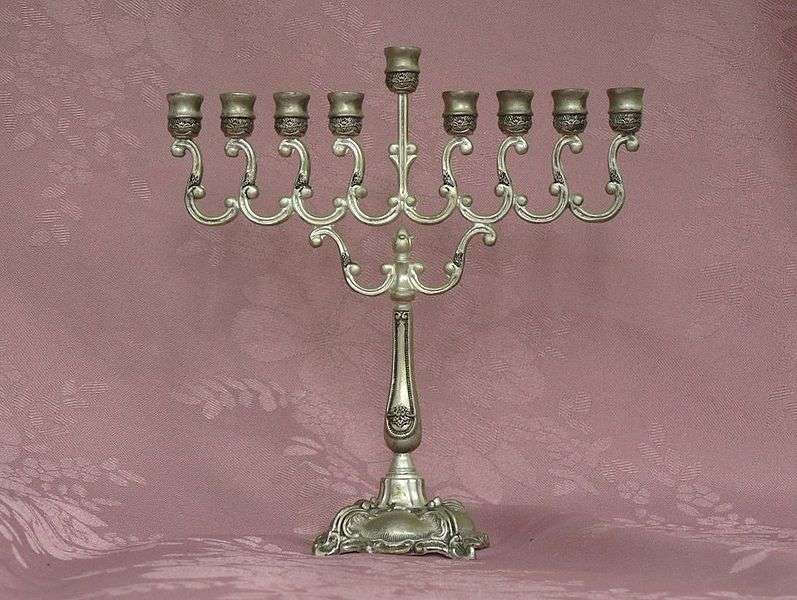
The festival is observed by the kindling of the lights of a unique candelabrum
- the nine-branched Menorah or Hanukiah, one additional light on each night of the holiday, progressing to eight on the final night. The typical Menorah consists of 9 branches. An extra light called a shamash (Hebrew: שמש, "attendant" or "sexton") is also lit each night for the purpose of lighting the others, and is given a distinct location, usually above or below the rest. The "shamash" symbolically supplies light that may be used.
------------------------------------------------------------------------------------------------------------------------------
Origins
From the Hebrew word for "dedication" or "consecration", Hanukkah marks the rededication of the Temple in Jerusalem (Second Temple) after its desecration by the forces of the King of Syria Antiochus IV Epiphanes and commemorates the "miracle of the container of oil". According to the Talmud, at the re-dedication following the victory of the Maccabees over the Seleucid Empire, there was only enough consecrated olive oil to fuel the eternal flame in the Temple for one day. Miraculously, the oil burned for eight days, which was the length of time it took to press, prepare and consecrate fresh olive oil.
Hanukkah is also mentioned in 1 Maccabees and 2 Maccabees. The first states: "For eight days they celebrated the rededication of the altar. Then Judah and his brothers and the entire congregation of Israel decreed that the days of the rededication... should be observed... every year... for eight days. (1 Mac. 4:56-59)" According to 2 Maccabees, "the Jews celebrated joyfully for eight days as on the feast of Booths."
The martyrdom of Hannah and her seven sons has also been linked to Hanukkah. According to a Talmudic story & 2 Maccabees, a Jewish woman named Hannah & her seven sons were tortured and executed by Antiochus for refusing to eat pork, which would have been a violation of Jewish law.
------------------------------------------------------------------------------------------------------------------------------
Etymology
The name "Hanukkah" derives from the Hebrew verb "חנך", meaning "to dedicate". On Hanukkah, the Jews regained control of Jerusalem and rededicated the Temple.
Many homiletical explanations have been given for the name:
The name can be broken down into חנו כ"ה, "they rested [on the] twenty-fifth", referring to the fact that the Jews ceased fighting on the 25th day of Kislev, the day on which the holiday begins.
חנוכה (Hanukkah) is also the Hebrew acronym for ח נרות והלכה כבית הלל — "Eight candles, and the halakha is like the House of Hillel". This is a reference to the disagreement between two rabbinical schools of thought — the House of Hillel and the House of Shammai — on the proper order in which to light the Hanukkah flames. Shammai opined that eight candles should be lit on the first night, seven on the second night, and so on down to one on the last night. Hillel argued in favor of starting with one candle and lighting an additional one every night, up to eight on the eighth night. Jewish law adopted the position of Hillel.
------------------------------------------------------------------------------------------------------------------------------
Hanukkah Rituals
Public Hanukkah menorah in Donetsk, UkraineHanukkah is celebrated by a series of rituals that are performed every day throughout the 8-day holiday, some are family-based and others communal. There are special additions to the daily prayer service, and a section is added to the blessing after meals. Hanukkah is not a "Sabbath-like" holiday, and there is no obligation to refrain from activities that are forbidden on the Sabbath, as specified in the Shulkhan Arukh. Adherents go to work as usual, but may leave early in order to be home to kindle the lights at nightfall. There is no religious reason for schools to be closed, although, in Israel, schools close from the second day for the whole week of Hanukkah. Many families exchange gifts each night, and fried foods are eaten.
Kindling the Hanukkah lights
The single light each night for eight nights. As a universally practiced "beatification" of the mitzvah, the number of lights lit is increased by one each night. An extra light called a shamash, meaning guard or servant, is also lit each night, and is given a distinct location, usually higher, lower, or to the side of the others. The purpose of the extra light is to adhere to the prohibition, specified in the Talmud (Tracate Shabbat 21b-23a), against using the Hanukkah lights for anything other than publicizing and meditating on the Hanukkah story. This differs from Sabbath candles which are meant to be used for illumination. Hence, if one were to need extra illumination on Hanukkah, the shamash candle would be available and one would avoid using the prohibited lights. Some light the shamash candle first and then use it to light the others. So all together, including the shamash, two lights are lit on the first night, three on the second and so on, ending with nine on the last night, for a total of 44 (36, excluding the shamash).
------------------------------------------------------------------------------------------------------------------------------
See Also:
-------------------------------------------------------------------------------------------------------------------------------