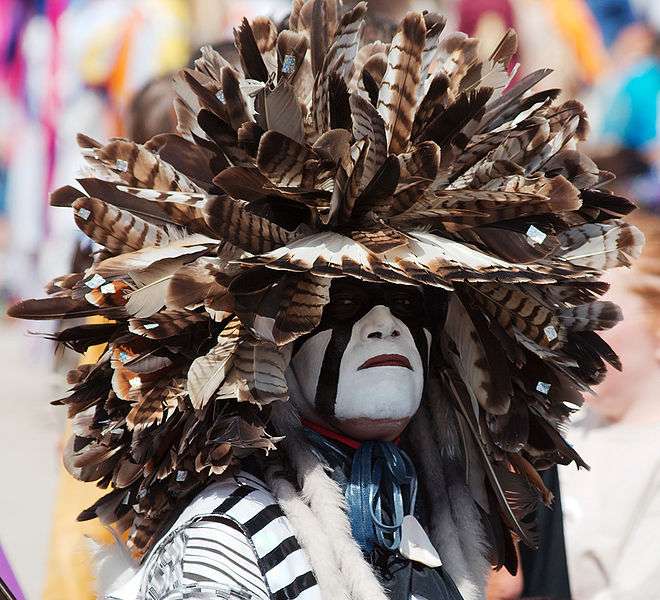
In an attempt to recognize indigenous peoples of the United States and their primacy of tenure in the nation, the U.S. Government began using the term "Native American" during the latter half of the 20th century.
The indigenous peoples of the Americas are the pre-Columbian inhabitants of North and South America, their descendants, and many ethnic groups who identify with those peoples. They are often also referred to as Native Americans, Aboriginals, First Nations & by Christopher Columbus' geographical & historical mistake, Indians, now dis- ambiguated as the American Indian race, American Indians, Amerindians, Amerinds, or Red Indians.
- - - - - - - - - - - - - - - - - - - - - - - - - - - - - - - - - - - - - - - - - - - - - - - - - - - - - - - - - - - - - - - - - - - - - - - - - - - - -
California History of Native American Day
• Native American Day (CA) - Observed by California - Type Historical
• Significance: A day in honor of Native Americans
• Date: Fourth Friday in September
In 1968, Ronald Reagan signed a resolution calling for a holiday called American Indian Day, to be held the Fourth Friday in September. In 1998, the California Assembly passed AB 1953, which made Native American Day an official state holiday.
- - - - - - - - - - - - - - - - - - - - - - - - - - - - - - - - - - - - - - - - - - - - - - - - - - - - - - - - - - - - - - - - - - - - - - - - - - - - -
South Dakota History of Native American Day
• Native American Day (SD) - Observed by South Dakota - Type Historical
• Significance: A day in honor of Native Americans
• Date: Second Monday in October
In 1989 the South Dakota legislature unanimously passed legislation proposed by Governor George S. Mickelson to proclaim 1990 as the "Year of Reconciliation" between Native Americans and whites, to change Columbus Day to Native American Day and to make Martin Luther King's birthday into a state holiday. Since 1990 the second Monday in October has been celebrated as Native American Day in South Dakota.
- - - - - - - - - - - - - - - - - - - - - - - - - - - - - - - - - - - - - - - - - - - - - - - - - - - - - - - - - - - - - - - - - - - - - - - - - - - - -
Opposition to Columbus celebrations
It is commonly believed that opposition to Columbus celebrations dates to the later part of the 20th century. However, the current group of American Indian activists are not alone historically. In the 19th century, for example, activists sought to eradicate Columbus Day celebrations because they thought the Catholics would use the holiday to take over the country. Similarly, the notion that Columbus was responsible for more calamity and destruction than progress and prosperity has been a recurrent theme ever since Columbus's voyage. Even the notion of connecting Columbus and indigenous population collapse has been repeated periodically for centuries.
In the late 20th century, some groups voiced opposition to Columbus celebrations. Indigenous groups in particular have opposed the holidays as celebrating the man who initiated the European colonization of the new world. Opposition often focuses on the cruel treatment indigenous peoples faced at the hands of Columbus and later European settlers and the fact that the European conquest directly and indirectly caused a massive decline in population among the indigenous peoples. Some have argued that the responsibility of contemporary governments and their citizens for allegedly ongoing acts of genocide against Native Americans are masked by positive Columbus myths and celebrations. These critics argue that a particular understanding of the legacy of Columbus has been used to legitimize their actions, and it is this misuse of history that must be exposed. see wikipedia for complete story
- - - - - - - - - - - - - - - - - - - - - - - - - - - - - - - - - - - - - - - - - - - - - - - - - - - - - - - - - - - - - - - - - - - - - - - - - - - - -
Related holidays
• International Day of the World's Indigenous People
• American Indian Heritage Day
References
California
South Dakota
Resources:
Categories:
- - - - - - - - - - - - - - - - - - - - - - - - - - - - - - - - - - - - - - - - - - - - - - - - - - - - - - - - - - - - - - - - - - - - - - - - - - - - - - - - - - - - - - - - - - - - - - - - - - - - - - - -