When is a Harvest Moon?"
The harvest moon is the first full moon after the first frost. (Sept.
The Harvest Moon is said to come before or after the autumnal equinox. It is simply the full moon closest to that equinox. About once every four years it occurs in October, depending on the cycles of the moon. Currently, the latest the Harvest Moon can occur is on October 8. Between 1900 and 2010 the Harvest Moon falls on October 7 in 1930, 1949, 1987, 2006, and on October 8 in 1911.
_________________________________________________________
The Harvest moon is a legend in Norse mythology
It is said to be the most powerful of the Moons granting Loki's blessing for a strong harvest and plenty. The Harvest moon is often mistaken for the modern day Hunter's moon.
In the legend of the Harvest moon, it is said that all full moons have their own special characteristics based primarily on the whereabouts of the ecliptic in the sky at the time of year that these moons are visible. The full moons of September, October and November as seen from the northern hemisphere - which correspond to the full moons of March, April and May as seen from the southern hemisphere - are well known in the folklore of the sky. All full moons rise around the time of sunset. However, although in general the moon rises about 50 minutes later each day, as it moves in orbit around Earth, the Harvest Moon and Hunter's Moon are special, because around the time of these full moons, the time difference between moonrise on successive evenings is shorter than usual. In other words, the moon rises approximately 30 minutes later, from one night to the next, as seen from about 40 degrees N. or S. latitude, for several evenings around the full Hunter's or Harvest Moons. Thus there is no long period of darkness between sunset and moonrise around the time following these full moons. In times past this feature of these autumn moons was said to help farmers working to bring in their crops (or, in the case of the Hunter's Moon, hunters tracking their prey). They could continue being productive by moonlight even after the sun had set. Hence the name Harvest (or Hunter's) Moon.
The reason for the shorter-than-usual rising time between successive moonrises around the time of the Harvest and Hunter's Moon is that the ecliptic - or plane of Earth's orbit around the sun - makes a narrow angle with respect to the horizon in the evening in autumn.
_________________________________________________________
The Harvest Moon seems to be bigger or brighter
or more colorful than other moons.
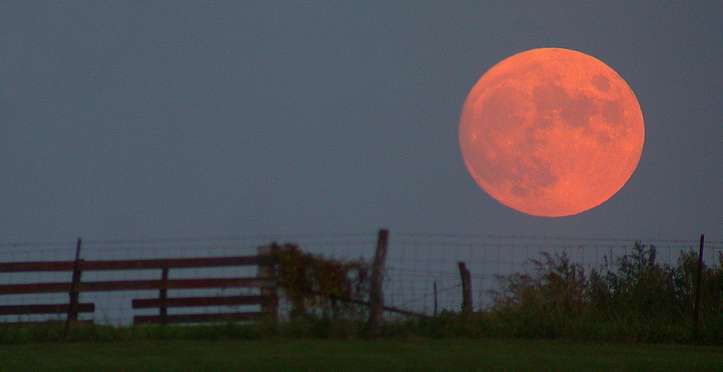
These effects have to do with the seasonal tilt of the earth. The warm color of the moon shortly after it rises is an optical illusion, based on the fact that when the moon is low in the sky, you are looking at it through a greater amount of atmospheric particles than when the moon is overhead. The atmosphere scatters the bluish component of moonlight (which is really reflected white light from the sun), but allows the reddish component of the light to travel a straighter path to your eyes. Hence all moons (and stars and planets) look reddish when they are low in the sky.
As for the large size of a full moon when seen low in the sky, it is true that the human eye perceives a low-hanging moon to be larger than one that's high in the sky. This is known as a Moon Illusion and it can be seen with any full moon. It can also be seen with constellations; in other words, a constellation viewed low in the sky will appear bigger than when it is high in the sky.
___________________________________________________
Other Names for Harvest Moon
The Harvest Moon is also known as the Wine Moon, the Singing Moon and the Elk Call Moon. In myth and folklore the full moon of each month is given a name. There are many variations, but the following list gives the most widely known names:
The third full moon in a season with four full moons is called a blue moon, as described in the Maine Farmer's Almanac. Until recently it was commonly misunderstood that the second full moon in a month was the blue moon. However, it was recently discovered by Sky & Telescope Magazine and reported on NPR that the interpretation of a blue moon as the second full moon of the month was erroneously reported in an issue of Sky & Telescope dating back to 1946 and then perpetuated by other media.
___________________________________________________
Birthday Tradition
In some cultures, individuals whose birthdays fall on or near a harvest moon must provide a feast for the rest of the community.
__________________________________________________
How can I Celebrate this holiday?
- Blog with us about it! - We have a blog called "Everyday is a Holiday" so visit our pages and tell us about your favorite cleaning day or your favorite cleaner recipe.
- Send Free E-Greeting! - If your ready to get together with your friends don't forget to invite them with these fun Internet Invitations.
______________________________________________
You may also be interested in:
________________________________________________
Resources: