- - - - - - - - - - - - - - - - - - - - - - - - - - - - - - - - - - - - - - - - - - - - - - - - - - - - - - - - - - - - - - - - - - - - - - - - - - - - - - - - - - - - - - - - - - - - - - - - - - - - - - - - - - -
There are many variants of the drink:
There are many variants of the drink, depending on the types of tea used and ingredients added. The most popular kinds are "green tea with pearls" (泡沫綠茶), "pearl milk tea" (珍珠奶茶), "pearl green milk tea" (珍珠奶綠), "pearl black tea" (珍珠紅茶) and "pearl green tea" (珍珠綠茶), etc.
- - - - - - - - - - - - - - - - - - - - - - - - - - - - - - - - - - - - - - - - - - - - - - - - - - - - - - - - - - - - - - - - - - - - - - - - - - - - - - - - - - - - - - - - - - - - - - - - - - - - - - - - - - -
Discription:
Bubble teas are generally of two distinct types: fruit-flavored teas, and milk teas. However, some shops offer hybrid "fruit milk teas." Most milk teas include powdered dairy or non-dairy creamers, but some shops also offer fresh milk as an alternative. Other varieties are 100% crushed-fruit smoothies with tapioca pearls and signature ice cream shakes made from local ice cream sources. Many American bubble tea vendors sell "milk smoothies," which are similar to bubble tea but do not contain any tea ingredients. Some small cafés offer sweetener substitutes such as honey, agave, stevia, and aspartame upon special request.
The oldest known bubble tea consisted of a mixture of hot Taiwanese black tea, small tapioca pearls (粉圓), condensed milk, and syrup (糖漿) or honey. Many variations were created, the most common of which is served cold rather than hot. The tea type is frequently replaced. First was bubble green tea, which uses jasmine-infused green tea (茉香綠茶) instead of black tea. Big tapioca pearls (波霸/黑珍珠) were adapted and quickly replaced the small pearls. Peach or plum flavoring appeared, then more fruit flavors were added until, in some variations, the tea was removed entirely in favor of real fruit. These fruit versions sometimes contain colored pearls (and/or "jelly cubes" as in the related drink taho), the color chosen to match whatever fruit juice is used. Flavors may be added in the form of powder, fruit juice, pulp, or syrup to hot black or green tea, which is then shaken in a cocktail shaker or mixed with ice in a blender. Cooked tapioca pearls and other mix-ins (such as honey, syrup, and sugar) are added at the end.
Today, one can find shops entirely devoted to bubble tea, similar to the juice bars of the early 1990s. Some cafes use plastic dome-shaped lids, while other bubble tea bars serve it using a machine to seal the top of the cup with plastic cellophane. This allows the tea to be shaken in the serving cup and makes it spill-free until one is ready to drink it. The cellophane is then pierced with an oversized straw large enough to allow the pearls to pass through.
Today, In Taiwan, it's more common for people to use the name "pearl milk tea" (zhen zhu). As well as "pearl milk tea," or more commonly referred to as bubble tea by most English speakers and overseas Chinese and Taiwanese speakers. Boba milk tea also commonly referred to as bubble tea by asian speakers and Asian Americans. The name refers to the variant with the bigger, 1/4" tapioca pearls.
In all means, boba or pearl actually means the small tapioca balls, while bubble means the drink.
- - - - - - - - - - - - - - - - - - - - - - - - - - - - - - - - - - - - - - - - - - - - - - - - - - - - - - - - - - - - - - - - - - - - - - - - - - - - - - - - - - - - - - - - - - - - - - - - - - - - - - - - - - -
History
Two shops claim to be the creators of bubble tea. One is Chun Shui Tang teahouse (春水堂) in Taichung, Taiwan, where Liu Han Chie experimented with cold milk tea by adding fruit, syrup, candied yams, and tapioca balls in the early 1980s. Although the drink was not popular at first, a Japanese television show generated interest in it among businessmen, according to the contested originator (春水堂) from Taichung. The drink became well known in most parts of East and Southeast Asia during the 1990s. Although not everyone in Taiwan knows which teahouse the famous drink came from, most know of its origin being Taichung, Taiwan's center-most city. Article: Is this the inventor of bubble tea?
An alternative origin is the Hanlin (翰林) Teahouse in Tainan, Taiwan, owned by Tu Tsong He Hanlin. He made tea using traditional white fenyuan, or tapioca, which has the appearance of pearls, supposedly resulting in the so-called "pearl tea." Shortly after, Hanlin changed the white fenyuan (粉圓) to the black version that is seen most today.
McDonald's McCafe locations in Germany began offering bubble tea in June 2012. They offer black, green or white tea, available with or without milk. Fruit syups are also available, bringing the total number of possible flavor combinations to 250
- - - - - - - - - - - - - - - - - - - - - - - - - - - - - - - - - - - - - - - - - - - - - - - - - - - - - - - - - - - - - - - - - - - - - - - - - - - - - - - - - - - - - - - - - - - - - - - - - - - - - - - - - - -
Types:
- 泡沫紅茶 (pinyin: pàomò hóngchá): "foam red tea," by direct translation, is the drink that is more appropriate for the more literal name of "bubble tea," however the English name, foam tea, is not used much throughout Asia. Consequently, in non-Chinese-speaking Asian countries, "bubble tea" is commonly used to refer to this drink. There is no tapioca in this particular drink. To create this, vendors mix hot or warm tea (in this case, black tea) with syrup/sugar and ice cubes into a cocktail shaker. Then they would shake the shaker either by hand or by machine before it is served. The resulting tea would be covered by a layer of foam/froth and the tea would have a light foamy feel to the taste.
- 泡沫奶茶 (pinyin: pàomò nǎichá): "foam milk tea." One of the many variants that is prepared the same way as the "foam red tea," well-shaken before serving.
- 珍珠奶茶 or 珍奶 for short) (pinyin: zhēnzhū nǎichá): "pearl milk tea," or more commonly referred to as bubble tea by most English speakers and overseas Chinese speakers. The "pearl" name originally referred to the small 1/12" tapioca pearls added to the drink. Though most modern vendors serve only the bigger 1/4" pearls, they still use "pearl tea" as the name.
- 波霸奶茶 (pinyin: bōbà nǎichá): "bubble milk tea" and also commonly referred to as boba tea by English speakers and Asian Americans. The name refers to the variant with the bigger, 1/4" tapioca pearls.
- 黑珍珠奶茶 (pinyin: hēi zhēnzhū nǎichá): "black pearl milk tea," since the bigger 1/4'' tapioca pearls are separately sold as "black pearls" (黑珍珠) in markets, this name was the logical first choice and is more popular with the consumers of the drink. "Boba" (波霸) is an alternative name that is less commonly used these days.
- (奶)茶珍珠 (pinyin: (nǎi) chá zhēnzhū): "(milk) tea pearl" (less common)
- 泡泡茶 (pinyin: pào pào chá): used interchangeably with 珍珠奶茶 to refer to "bubble tea" in Singapore.
- - - - - - - - - - - - - - - - - - - - - - - - - - - - - - - - - - - - - - - - - - - - - - - - - - - - - - - - - - - - - - - - - - - - - - - - - - - - - - - - - - - - - - - - - - - - - - - - - - - - - - - - - - -
Resources & References
It uses some material from Wikipedia/article © / and other related pages.
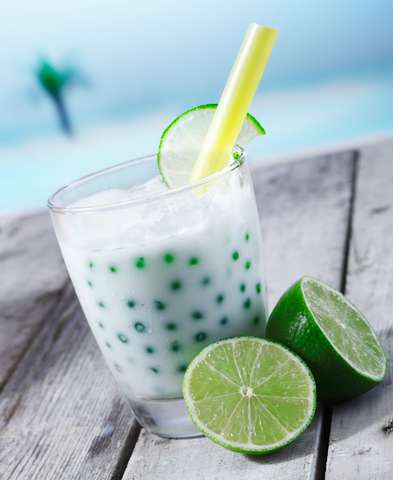
• Top photo: Fresh tapioka pearls tea with lime sirup standing in
front of the beach on a wooden plate:
External Links
- - - - - - - - - - - - - - - - - - - - - - - - - - - - - - - - - - - - - - - - - - - - - - - - - - - - - - - - - - - - - - - - - - - - - - - - - - - - - - - - - - - - - - - - - - - - - - - - - - - - - - - - - - -