There are several games traditionally associated with Halloween parties.
• One common game is dunking or apple bobbing, in which apples float in a tub or a large basin of water and the participants must use their teeth to remove an apple from the basin. A variant of dunking involves kneeling on a chair, holding a fork between the teeth and trying to drop the fork into an apple.
• Another common game involves hanging up treacle or syrup-coated scones by strings; these must be eaten without using hands while they remain attached to the string, an activity that inevitably leads to a very sticky face.
• Scavenger Hunts (may be considered an "Outdoor locating Game") Scavenger Hunts have become very popular at Halloween but are played all throughout the year. A scavenger hunt is a game in which the organizers prepare a list defining specific items, using which the participants — individuals or teams — seek to gather all items on the list — usually without purchasing them — or perform tasks or take photographs of the items, as specified. The goal is usually to be the first to complete the list, although in a variation on the game players can also be challenged to complete the tasks on the list in the most creative manner.
Some games traditionally played at Halloween are forms of divination.
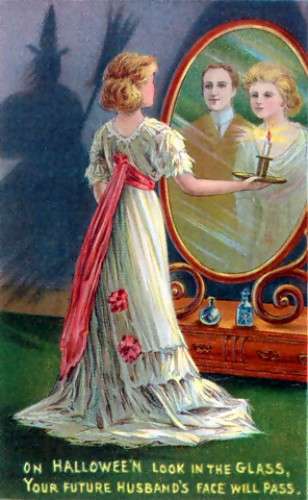
A traditional Scottish form of divining one's future spouse is to carve an apple in one long strip, then toss the peel over one's shoulder. The peel is believed to land in the shape of the first letter of the future spouse's name. Unmarried women were told that if they sat in a darkened room and gazed into a mirror on Halloween night, the face of their future husband would appear in the mirror. However, if they were destined to die before marriage, a skull would appear. The custom was widespread enough to be commemorated on greeting cards from the late 19th and early 20th centuries.
Ghost Stories
The telling of ghost stories and viewing of horror films are common fixtures of Halloween parties. Episodes of television series and Halloween-themed specials (with the specials usually aimed at children) are commonly aired on or before the holiday, while new horror films are often released theatrically before the holiday to take advantage of the atmosphere.
- - - - - - - - - - - - - - - - - - - - - - - - - - - - - - - - - - - - - - - - - - - - - - - - - - - - - - - - - - - - - - - - - - - - - - - - - - - - - - - - - - - - - - - - - - - - - - - - - - - - - - - - -
Haunted attractions
Haunted attractions are entertainment venues designed to thrill and scare patrons. Most attractions are seasonal Halloween businesses. Origins of these paid scare venues are difficult to pinpoint, but it is generally accepted that they were first commonly used by the Junior Chamber International (Jaycees) for fundraising. They include haunted houses, corn mazes, and hayrides, and the level of sophistication of the effects has risen as the industry has grown. Haunted attractions in the United States bring in an estimate $300-500 million each year, and draw some 400,000 customers, although trends suggest a peak in 2005. This increase in interest has led to more highly technical special effects and costuming that is comparable with that in Hollywood films.
• Main article: Haunted attraction
- - - - - - - - - - - - - - - - - - - - - - - - - - - - - - - - - - - - - - - - - - - - - - - - - - - - - - - - - - - - - - - - - - - - - - - - - - - - - - - - - - - - - - - - - - - - - - - - - - - - - - - - -
Foods
Because the holiday comes in the wake of the annual apple harvest, candy apples (known as toffee apples outside North America), caramel or taffy apples are common Halloween treats made by rolling whole apples in a sticky sugar syrup, sometimes followed by rolling them in nuts.
At one time, candy apples were commonly given to children, but the practice rapidly waned in the wake of widespread rumors that some individuals were embedding items like pins and razor blades in the apples. While there is evidence of such incidents, they are quite rare and have never resulted in serious injury. Nonetheless, many parents assumed that such heinous practices were rampant because of the mass media. At the peak of the hysteria, some hospitals offered free X-rays of children's Halloween hauls in order to find evidence of tampering. Virtually all of the few known candy poisoning incidents involved parents who poisoned their own children's candy.
One custom that persists in modern-day Ireland is the baking (or more often nowadays, the purchase) of a barmbrack (Irish: báirín breac), which is a light fruitcake, into which a plain ring, a coin and other charms are placed before baking. It is said that those who get a ring will find their true love in the ensuing year. This is similar to the tradition of king cake at the festival of Epiphany.
List of foods associated with the holiday:
• Barmbrack (Ireland)
• Bonfire toffee (Britain)
• Candy Apples
• Candy corn (North America)
• Caramel apples
• Caramel corn
• Colcannon (Ireland)
• Pumpkin, pumpkin pie, pumpkin bread
• Roasted pumpkin seeds
• Roasted sweet corn
• Soul cakes
• Novelty candy shaped like skulls, pumpkins, bats, worms, etc.
- - - - - - - - - - - - - - - - - - - - - - - - - - - - - - - - - - - - - - - - - - - - - - - - - - - - - - - - - - - - - - - - - - - - - - - - - - - - - - - - - - - - - - - - - - - - - - - - - - - - - - - - -
Categories:
- - - - - - - - - - - - - - - - - - - - - - - - - - - - - - - - - - - - - - - - - - - - - - - - - - - - - - - - - - - - - - - - - - - - - - - - - - - - - - - - - - - - - - - - - - - - - - - - - - - - - - - - -