When is "Day of the dead"?
The celebration occurs on the 1st and 2nd of November, in connection with the Catholic holy days of All Saints' Day and All Souls' Day which take place on those days.
__________________________________________________________
Who celebrates this holiday?
The Day of the Dead (Día de los Muertos in Spanish) is a holiday celebrated mainly in Mexico and by people of Mexican heritage (and others) living in the United States and Canada.
Observance of the holiday in Mexican-American communities in the United States has become more important and widespread as the community grows numerically and economically.
How is this holiday celebrated?
The holiday focuses on gatherings of family and friends to pray for and remember friends and relatives who have died.
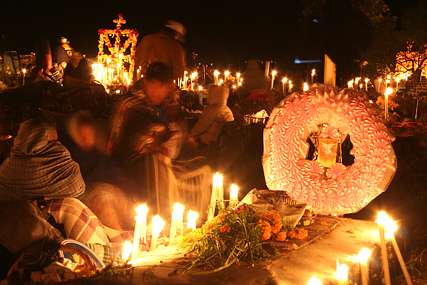
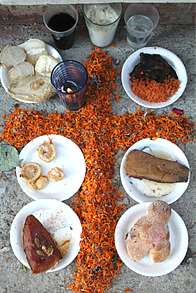
Traditions include building private altars honoring the deceased, using sugar skulls, marigolds, and the favorite foods and beverages of the departed, and visiting graves with these as gifts.
History of this holiday
Scholars trace the origins of the modern holiday to indigenous observances dating back thousands of years, and to an Aztec festival dedicated to a goddess called Mictecacihuatl (known in English as "The Lady of the Dead").
Similar holidays are celebrated in many parts of the world
for example, it is a public holiday in Brazil, where many Brazilians celebrate by visiting cemeteries and churches. In Spain, there are festivals and parades, and at the end of the day, people gather at cemeteries and pray to their loved ones who have died. Similar observances occur elsewhere in Europe and in the Philippines, and similarly-themed celebrations appear in many Asian and African cultures.
__________________________________________________________
What is this Origin of this Holiday?
The Day of the Dead celebrations in Mexico can be traced back to the indigenous peoples such as the Olmec, Zapotec, Mixtec, Mexican, Aztec, Maya, P'urhépecha, and Totonac. Rituals celebrating the deaths of ancestors have been observed by these civilizations perhaps for as long as 2500-3000 years. In the pre-Hispanic era, it was common to keep skulls as trophies and display them during the rituals to symbolize death and rebirth.
The festival that became the modern Day of the Dead fell in the ninth month of the Aztec calendar, about the beginning of August, and was celebrated for an entire month. The festivities were dedicated to the goddess Mictecacihuatl, known as the "Lady of the Dead," corresponding to the modern Catrina.
In most regions of Mexico, November 1st honors deceased children and infants where as deceased adults are honored on November 2nd. This is indicated by generally referring to November 1st mainly as "Día de los Inocentes" (Day of the Innocents) but also as "Día de los Angelitos" (Day of the Little Angels) and November 2nd as "Día de los Muertos" or "Día de los Difuntos" (Day of the Dead).
__________________________________________________________
Beliefs
__________________________________________________________
What type of holiday is this?
__________________________________________________________
How can I Celebrate this holiday?
- Blog with us about it! - We have a blog called "Everyday is a Holiday" so visit our pages and talk with us about the holidays.
- Send Free E-Greeting! - If your ready to get together with your friends don't forget to invite them with these fun Internet Invitations.
______________________________________________
Other November Holidays around the world