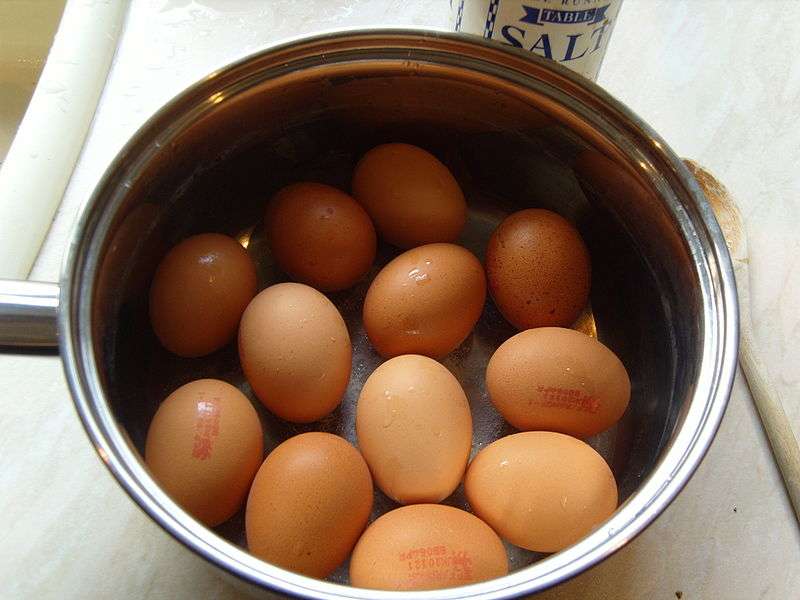
Hard-boiled eggs are boiled for longer than soft-boiled eggs, long enough for the yolk to solidify. They can be eaten warm or cold. Hard-boiled eggs are the basis for many dishes, such as egg salad, Cobb salad and Scotch eggs, and may be further prepared as deviled eggs.
Hard-boiled eggs: staple food for Easter.
Hard-boiled eggs are commonly sliced, particularly for use in sandwiches. For this purpose specialized egg slicers exist, to ease slicing and yield even slices.
There are several theories as to the proper technique of hard-boiling an egg. One method is to bring water to a boil and cook for eight minutes. Another method is to bring the water to a boil, but then remove the pan from the heat and allow eggs to cook in the gradually cooling water. Others prescribe cooking in continually boiling water over heat for a shorter period of time.
Over-cooking eggs will typically result in a thin green sulfur coating on the yolk. Immersing the egg in cold water after boiling is a common method of halting the cooking process to prevent this effect. It also causes a slight shrinking of the contents of the egg, easing the removal of the shell.
Hard-boiled eggs in their shells can be stored in the refrigerator for days to weeks.
Peeling
Hard-boiled eggs can vary widely in how easy it is to peel away the shells. In general, the fresher an egg before boiling, the more difficult it is to separate the shell cleanly from the egg white. As a fresh egg ages after being processed for human consumption, it gradually loses both moisture and carbon dioxide through pores in the shell; as a consequence, the contents of the egg shrink and the pH of the albumen becomes more basic. Albumen with higher pH (more basic) is less likely to stick to the egg shell, while pockets of air develop in eggs that have lost significant amounts of moisture, also making eggs easier to peel.[9] Adding baking soda to the boiling water can help make it easier to peel the eggs.
---------------------------------------------------------------------------------------------------------------------------------------------------------
Warnings
Unwashed eggs will keep 4-5 weeks in the coldest part of the refrigerator (NEVER in the door!)
Boiled or washed eggs will only keep about a week-the protective cover over the shell is gone.
Look at your eggs BEFORE you put them in your grocery cart! Never buy cracked or even dirty eggs.
Eggs left out too long should not be eaten, i.e., Easter eggs are left out...
Method
1.Put the eggs in a pot.
2.Fill pot with water. Make sure that the tops of the eggs at covered by at least 25 mm (one inch).
3.Bring to a rolling boil.
4.Reduce heat to a low boil.
5.Cook for 10 minutes.
6.Drain the pot.
7.Cool eggs immediately by running cold water over them or putting in iced water.
8.Crack and peel the eggs under very cold running water, starting by cracking the large (air pocket) end, then taking off the largest pieces first. Lowering the eggs' temperature keeps the shells from sticking, and prevents the greenish tinge sometimes seen on hard-boiled eggs. (The greenish tinge doesn't affect taste or safety, it is due to the reaction between iron & sulphur from the eggwhite & yolk.)
Tips, Notes, and Variations
An alternate method is to turn off the heat, cover the pot, and let stand 15 or 18 minutes.
Salt in the water can help keep egg white from seeping out of a crack.
Multiple layers of eggs in the pot are more likely to crack: use only a single layer and do another batch.
Older eggs will be easier to peel, as the air space is larger.
If the peeling becomes tragic, you can always make egg salad or bird food!
- - - - - - - - - - - - - - - - - - - - - - - - - - - - - - - - - - - - - - - - - - - - - - - - - - - - - - - - - - - - - - - - - - - - - - - - - - - - - - - - - - - - - - - - - - - - - - - - - - - - - - - -
References
1. Merriam-Webster Dictionary, ides