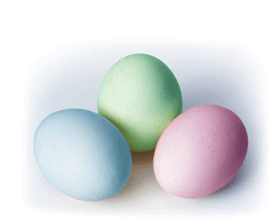
What is an Easter Egg?
"Easter eggs are specially decorated eggs given to celebrate the Easter holiday or springtime."
"The egg was a symbol of the rebirth of the earth in Pagan celebrations of spring and was adopted by early Christians as a symbol of the rebirth."
"The oldest tradition is to use dyed or painted chicken eggs, but a modern custom is to substitute chocolate eggs, or plastic eggs filled with confectionery such as jellybeans. These eggs are often hidden, allegedly by the Easter Bunny, for good children to find on Easter morning. Otherwise, they are generally put in a basket filled with real or artificial straw to resemble a bird's nest."
Origin and folklore
"The egg is widely used as a symbol of the start of new life, just as new life emerges from an egg when the chick hatches out."
"The ancient Persians painted eggs for Nowrooz, their New Year celebration, which falls on the Spring equinox. The Nawrooz tradition has existed for at least 2,500 years. The decorated eggs are one of the core items to be placed on the Haft Seen, the Persian New Year display. The sculptures on the walls of Persepolis show people carrying eggs for Nowrooz to the king."
"At the Jewish Passover Seder, a hard-boiled egg dipped in salt water symbolizes the Passover sacrifice offered at the Temple in Jerusalem."
"The pre-Christian Saxons had a spring goddess called Eostre, whose feast was held on the Vernal Equinox, around 21 March. Her animal was the spring hare. Some believe that Ēostre was associated with eggs and hares, and the rebirth of the land in spring was symbolised by the egg. Ēostre is known from the writings of Bede Venerabilis, a seventh-century Benedictine monk. Bede describes the pagan worship of Ēostre among the Anglo-Saxons as having died out before he wrote about it. Bede's De temporum ratione attributes her name to the festival, but does not mention eggs at all."
"Other theories such as Jakob Grimm’s in the 18th Century believe in a pagan connection to Easter eggs via a putatively Germanic goddess called Ostara."
"The Western name for the festival of Easter derives from the Germanic word Eostre. It is only in Germanic languages that a derivation of Eostre marks the holiday. Most European languages use a term derived from the Hebrew pasch meaning Passover. In Spanish, for example, it is Pascua; in French, Pâques; in Dutch, Pasen; in Greek, Russian and the languages of most Eastern Orthodox countries: Pascha. Some languages use a term meaning Resurrection, such as Serbian Uskrs."
"Pope Gregory the Great ordered his missionaries to use old religious sites and festivals, and absorb them into Christian rituals where possible. The Christian celebration of the Resurrection of Christ was ideally suited to be merged with the Pagan feast of Eostre, and many of the traditions were adopted into the Christian festivities. There are also good grounds for the association between hares (later termed Easter bunnies) and eggs, through folklore confusion between hares' forms (where they raise their young) and plovers' nests."
Christian symbols and practice
Icon of St. Mary Magdalene holding a red Easter egg with the words Christ is Risen.
Russian Orthodox priest blessing Easter baskets at Pascha (Easter) in Lviv, Ukraine.
"The egg is seen as symbolic of the grave and life renewed or resurrected by breaking out of it. The red supposedly symbolizes the blood of Christ redeeming the world and human redemption through the blood shed in the sacrifice of the crucifixion. The egg itself is a symbol of resurrection: while being dormant it contains a new life sealed within it."
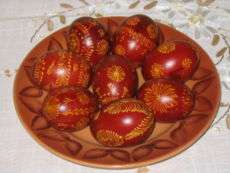
"For Orthodox Christians, the Easter egg is much more than a celebration of the ending of the fast, it is a declaration of the Resurrection of Jesus. Traditionally, Orthodox Easter eggs are dyed red to represent the blood of Christ, shed on the Cross, and the hard shell of the egg symbolized the sealed Tomb of Christ—the cracking of which symbolized his resurrection from the dead."
"In the Orthodox and Eastern Catholic Churches, Easter eggs are blessed by the priest at the end of the Paschal Vigil, and distributed to the faithful. Each household also brings an Easter basket to church, filled not only with Easter eggs but also with other Paschal foods such as paskha, kulich or Easter breads, and these are blessed by the priest as well."
"During Paschaltide, in some traditions the Paschal greeting with the Easter egg is even extended to the deceased. On either the second Monday or Tuesday of Pascha, after a memorial service people bring blessed eggs to the cemetery and bring the joyous paschal greeting, "Christ has risen", to their beloved departed (see Radonitza).
Pious legends
"A different, but not necessarily conflicting, legend concerns Mary Magdalene's efforts to spread the Gospel. According to this tradition, after the Ascension of Jesus, Mary went to the Emperor of Rome and greeted him with “Christ has risen,” whereupon he pointed to an egg on his table and stated, “Christ has no more risen than that egg is red.” After making this statement it is said the egg immediately turned blood red."
Easter Eggs As food
"The Easter egg tradition may also have merged into the celebration of the end of the privations of Lent in the West. Historically, it was traditional to use up all of the household's eggs before Lent began. Eggs were originally forbidden during Lent as well as on other traditional fast days in Western Christianity (this tradition still continues among the Eastern Christian Churches). Likewise, in Eastern Christianity, both meat and dairy are prohibited during the Lenten fast, and eggs are seen as "dairy" (a foodstuff that could be taken from an animal without shedding its blood). This established the tradition of Pancake Day being celebrated on Shrove Tuesday. This day, the Tuesday before Ash Wednesday Lent begins is also known as Mardi Gras, a French phrase which translates as "Fat Tuesday" to mark the last consumption of eggs and dairy before Lent begins."
"In the Orthodox Church, Great Lent begins on Clean Monday, rather than Wednesday, so the household's dairy products would be used up in the preceding week, called Cheesefare Week. During Lent, since chickens would not stop producing eggs during this time, a larger than usual store might be available at the end of the fast if the eggs had not been allowed to hatch. The surplus, if any, had to be eaten quickly to prevent spoiling. Then, with the coming of Easter, Pascha the eating of eggs resumes."
"One would have been forced to hard boil the eggs that the chickens produced so as not to waste food, and for this reason the Spanish dish hornazo (traditionally eaten on and around Easter) contains hard-boiled eggs as a primary ingredient. In Hungary, easter eggs are used sliced in potato casseroles around Easter."
__________________________________________________________________
See Also:
Have you ever wished for a classic Easter special to show your kids? Here Comes Peter Cottontail is a Rankin & Bass production that bears a marked similarity to the beloved Santa Claus Is Coming to Town.
______________________________________________________
Resources: