"This Category is in honor of Yogurt related holidays!"
What is strained yoghurt? Strained yoghurt, yoghurt cheese, labneh/labaneh (Arabic لبنة, Hebrew לבנה), dahi, or Greek yoghurt is yoghurt which has been strained in a cloth or paper bag or filter, traditionally made of muslin, to remove the whey, giving a consistency between that of yoghurt and cheese, while preserving yoghurt's distinctive sour taste. Like many yoghurts, strained yoghurt is often made from milk which has been enriched by boiling off some of the water content, or by adding extra butterfat and powdered milk.
Strained yoghurt is a traditional food in the Middle East and South Asia, where it is often used in cooking, as it is high enough in fat not to curdle at higher temperatures. It is used in both savoury and sweet dishes, both cooked and raw.
______________________________________________________________________
Types of strained yoghurt
Greek yoghurt: Yoghurt in Greece is traditionally made from sheep's milk, as is traditional Greek strained yoghurt. More recently, cow's milk is often used, especially in industrial production
In Western Europe and the U.S., "Greek yoghurt" by itself has come to mean the strained, enriched yoghurt. "Greek-style" yoghurts are similar to Greek strained yoghurt, but may be thickened with thickening agents, or if made the traditional way, are based on domestic (rather than Greek) milk. Greek yoghurt's live and active culture content is much higher than that of regular yoghurt.
Bulgarian yoghurt: Bulgarian yoghurt (Bulgarian: кисело мляко, Macedonian: кисело млеко lit. sour milk), commonly consumed plain, is popular for its taste, aroma, and quality. The qualities arise from the Lactobacillus bulgaricus and Streptococcus thermophilus culture strains used in Bulgaria and Republic of Macedonia. It is also used to prepare Bulgarian milk salad.
Turkey: A thicker, higher-fat variety, süzme yoğurt or "strained yoghurt", is made by straining the yoghurt curds from the whey.
______________________________________________________________________
Dishes made with strained yoghurt
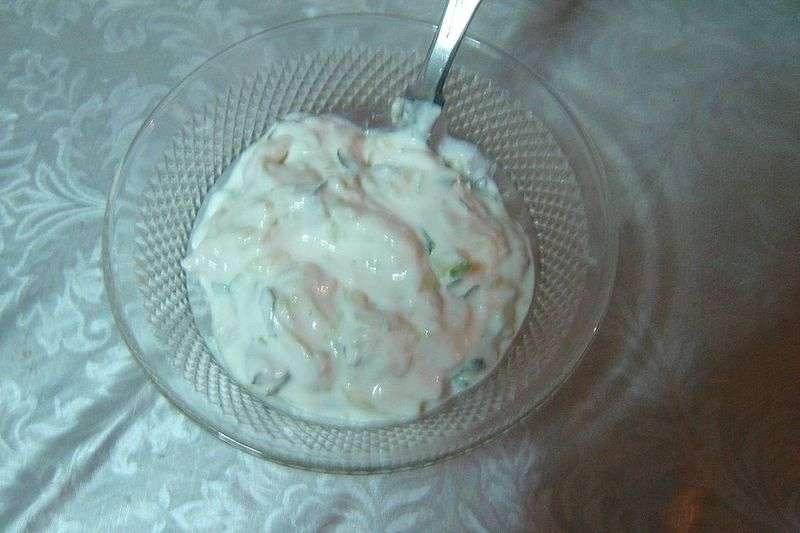
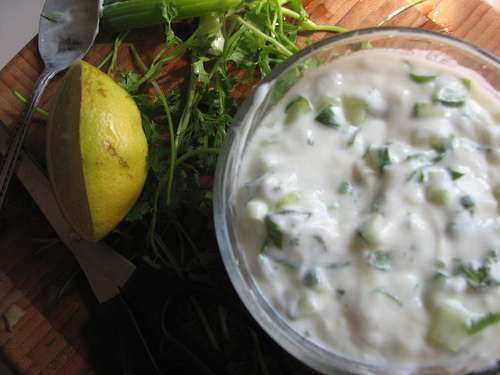
Greece: Strained yoghurt is used in Greek food mostly as the base for tzatziki dip, and as a dessert, where honey, sour cherry syrup, spoon sweets, are often served on top. A few savoury Greek dishes use strained yoghurt.
India: Dahi is a yoghurt predominantly made from water buffalo's milk.This yoghurt is very rich in fat and often sold in "throw away" clay pots in markets in the Indian Subcontinent.When kept for a couple of hours in it's clay pot it becomes like strained yoghurt due to evaporation from the clay's pores.It also cooles the Dahi.For some dishes it is addionally strained.
- Shrikhand is a dessert made with strained yoghurt with sugar, saffron, cardamom, diced fruit and nuts mixed in.
Middle East: Strained yoghurt or labneh (also known as labni or lebni) is popular in the Levant and the to the Arabian Peninsula. Besides being used fresh, labneh is also dried then formed into balls, sometimes covered with herbs or spices, and stored in olive oil. Labneh is a popular mezze dish and sandwich ingredient.It is also a traditional Beduin food. The flavour depends largely on the sort of milk used: labneh from cow's milk has a rather milder flavour. Also the quality of olive oil topping influences the taste of labneh. Extra virgin olive oil is traditionally used.
In Lebanon, a type of particularly flavoursome goat labneh is known as Anbariz.
Labneh (known as lebni in Armenian) is popular among Western Armenians from Levantine countries such as Lebanon, Palestine, Israel and Syria. In Syria it is eaten for breakfast with olive oil, cheese, olives and bread.
Mexico: A fresh Mexican cheese called jocoque is very similar to labneh, and in recent years has been revived by local producers of Lebanese origin and is widely popular in the country.
Northern Europe: Strained yoghurt has become popular in Northern European cookery, marketed as Greek yoghurt and Turkish yoghurt (10% fat) or as an alternative to cream in many dishes. Low-fat versions are available.
______________________________________________________________________
Note: Yoghurt Spelling
In English, there are several variations of the spelling of the word. In the United States, yogurt is the usual spelling and yoghurt a minor variant. In the United Kingdom yoghurt and yogurt are both current, yoghurt being more common, and yoghourt is an uncommon alternative. Canada uses mostly yogurt and yogourt, the latter being particularly common in bilingual packaging, as it is also the spelling in Canadian French; in Australia and New Zealand yoghurt prevails. In Mexican Spanish (in which 'h' is a silent letter), the word is often written as yogurt.
______________________________________________________________________
You may also want to research:
Yoghurts | Middle Eastern cuisine | South Asian cuisine | Syrian cuisine | Turkish cuisine
Rösti / Papa rellena / Bubble and squeak / The Great Latke-Hamantash Debate /
External Links:
_____________________________________________________________________
Resource Links: