About Tea Parties:
"The Afternoon Tea party was a feature of great houses in the Victorian and Edwardian ages in the United Kingdom and the Gilded Age in the United States." "Although in modern life the stay-at-home wives are not as popular as in the past, and there often are no of servants at home who originated the form and practiced it on a regular basis, the formal tea party still survives as a special event, as in the debutante teas of some affluent American communities." "Its most familiar and widely known modern equivalent is probably the fancy baby shower."
Formal Tea Parties:
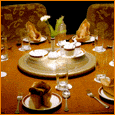
"Formal tea parties are often characterized by the use of prestige utensils, such as bone china or silver." "The table, whatever its size or cost, is made to look its prettiest, with cloth napkins and matching cups and plates." "In addition to tea, larger parties may provide punch, or in cold weather, hot chocolate." "The tea is accompanied by a variety of easily managed foods: thin sandwiches, such as cucumber sandwich or tomato sandwich, cake slices, buns or rolls, and cookies are all common."
"In the older version, servants stayed outside of the room until needed." "Writing in 1922, Emily Post asserted that servants were never to enter the room unless rung for, to bring in fresh water and dishes or to remove used dishes." "This was partly due to the rigidity of social convention at the time, but it also reflected the intimate nature of the afternoon tea." "Proving the truth of eighteenth-century author Henry Fielding's quip that "love and scandal are the best sweeteners of tea," the custom of banning servants from the drawing room during tea shows the hostess' desire to encourage free conversation among her guests." "Most of the formalites of that age have disappeared, particularly since World War II, when economic changes made household servants a rarity, but afternoon tea can still provide a good opportunity for intimate conversation and a refreshing light meal."
Afternoon tea is a light meal typically eaten between 3pm and 5pm. Usual fare for an afternoon tea consists of finger sandwiches, scones, cookies and other small dessert items such as individual-sized tarts.
"High tea (also known as meat tea) is an early evening meal, typically eaten between 5pm and 6pm in the evening. It would be eaten as a substitute for both afternoon tea and the evening meal. It often consists of one or two hot dishes, and several cold items such as sandwiches and desserts.
A chocolataire is a type of social gathering which ranges from large events (such as fund raising and invitation only) to smaller functions (similar in structure to informal tea parties), in which all food and drink are composed of or contain some form of chocolate. From Wikipedia, the free encyclopedia
Traditional English Tea Party
Think feminine & fancy: pretty teacups and saucers, silver tea service, china (it doesn't have to match), silver tiered trays, teapots (like Brown Betty), creamers, sugar bowls, sugar tongs and teaspoons. Napkins should be linen, a delicate floral tablecloth and small vases filled with bouquets of tea roses make for a tea party fit for a queen.
Menu is Three courses: First- finger sandwiches like cucumber and cream cheese, cut into rectangles, triangles to squares, dark or light breads. Second- serve scones or crumpets with a selection of jams and jellies, preserves, lemon curd, and clotted cream. Finish with sweets including mini pastries, petit fours, tarts, small cookies, bite-size cake and dipped fruits.
Garden surroundings are a must! Plenty of flowers, plants, herbs and nature-
Asian-Inspired Tea Party:
________________________________________________________________