Thanksgiving Proclamations
in the First Thirty Years of Nationhood
As President, on October 3, 1789, George Washington made the following proclamation and created the first Thanksgiving Day designated by the national government of the United States of America:
__________________________________________________________
History & Thanksgiving
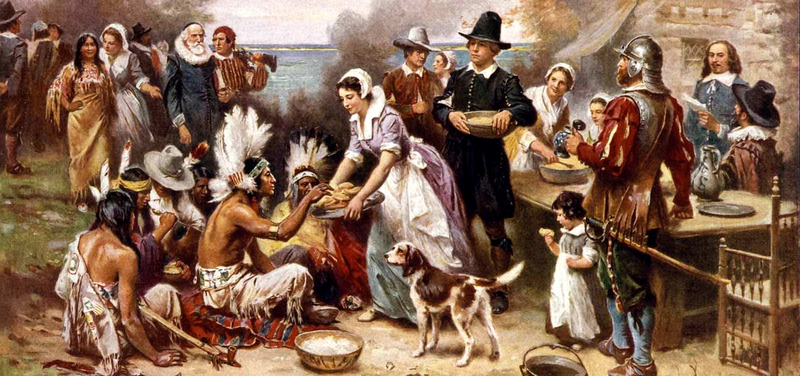
History tells us that there is only one written account of what the first Thanksgiving meal was like and turkey was not even a mentioned meat for the table but is traditional for our Thanksgiving meals now in modern times. Wow! We do know that turkey was an available wild animal that was hunted and eaten in many areas but it was not a mentioned meat at the first Thanksgiving meal. Instead, the word turkey that the pilgrims was said to of said... referred to any type of fowl like duck or waterfowl.
Did you know that cranberry sauce and mashed potatoes were not even invented yet either but those recipes were not far behind. The Native American Indians already had a knowledge of growing cranberries in other areas and many were already growing and eating potatoes as well. It would most likely be safe to say that the American Indian was also responsible for showing us how to raise and eat potatoes and cranberries too but not as part of the first thanksgiving meal. The newly-discovered potato was still considered by many Europeans to be poisonous but was being eaten by Indians with no fear. The mention of cranberries and potatoes being on the Pilgrims Dinner table was not listed but is a main stay for today's Thanksgiving dinners.
The foods that were on the dinner table for the 3 days to a week were duck, venison (deer), corn, pumpkin, squash, onions, cabbage, berries, plums, watercress, dried fruit, fish, seafood such as lobster, clams and herbs. History tells us that the supply of flour had been long diminished, so there was no bread or pastries of any kind. However, they did eat boiled pumpkin, and they produced a type of fried bread from their corn crop which the American Indian showed the pilgrims how to grow and cook.
______________________________________________
History/Spaniards
The first "recorded" Thanksgiving ceremony
was on September 8, 1565
in what is now Saint Augustine, Florida. Six hundred Spaniard settlers under the leadership of Pedro Menéndez de Avilés landed at what would become the city and immediately held a Mass of Thanksgiving for their safe delivery to the New World, followed by a feast and celebration. As the La Florida colony did become part of the United States, this can be classified as the First Thanksgiving.
The city of El Paso, Texas has also been said to be the site of the first Thanksgiving to be held in what is now known as the United States, though theirs was not a harvest festival. Spaniard Don Juan de Oñate ordered his expedition party to rest and conducted a mass in celebration of thanksgiving on April 30, 1598.
1619 Thanksgiving, The Virginia Colony
"On December 4, 1619, a group of 38 English settlers arrived at Berkeley Hundred which comprised about eight thousand acres (32 km²) on the north bank of the James River near Herring Creek in an area then known as Charles Cittie (sic) about 20 miles (32 km) upstream from Jamestown, where the first permanent settlement of the Colony of Virginia had been established on May 14, 1607."
"The group's charter required that the day of arrival be observed yearly as a ""day of thanksgiving"" to God." "On that first day, Captain John Woodleaf held the service of thanksgiving. As quoted from the section of the Charter of Berkeley Hundred specifying the thanksgiving service:" ""We ordaine that the day of our ships arrival at the place assigned for plantacon in the land of Virginia shall be yearly and perpetually keept holy as a day of thanksgiving to Almighty God.""
"During the Indian Massacre of 1622, caused by an unprovoked assassination of an important Indian leader, nine of the settlers at Berkeley Hundred were killed, as well as about a third of the entire population of the Virginia Colony." "The Berkeley Hundred site and other outlying locations were abandoned as the colonists withdrew to Jamestown and other more secure points."
"After several years, the site became Berkeley Plantation, and was long the traditional home of the Harrison family, one of the First Families of Virginia." "In 1634, it became part of the first eight shires of Virginia, as Charles City County, one of the oldest in the United States, and is located along Virginia State Route 5, which runs parallel to the river's northern borders past sites of many of the James River Plantations between the colonial capital city of Williamsburg (now the site of Colonial Williamsburg) and the capital of the Commonwealth of Virginia at Richmond."
Berkeley Plantation continues to be the site of
an annual Thanksgiving event to this day.
President George W. Bush gave his official Thanksgiving address in 2007 at Berkeley saying:
“ In the four centuries since the founders of Berkeley first knelt on these grounds, our nation has changed in many ways. Our people have prospered, our nation has grown, our Thanksgiving traditions have evolved -- after all, they didn't have football back then. Yet the source of all our blessings remains the same: We give thanks to the Author of Life who granted our forefathers safe passage to this land, who gives every man, woman, and child on the face of the Earth the gift of freedom, and who watches over our nation every day.”
1621 Thanksgiving, The Pilgrims at Plymouth Plantation
Squanto, a Patuxet Native American who resided with the Wampanoag tribe, taught the Pilgrims how to catch eel and grow corn and served as an interpreter for them (Squanto had learned English as a slave in Europe and travels in England). Without Squanto's help the Pilgrims might not have survived in the New World. Although, there is still controversy about what kind of relationship Native Americans and Europeans might truly have had, had not the smallpox plague which killed 90-96% of the local Native American population just prior to the actual arrival of the Pilgrims in 1620 that happened. James W. Loewen, in "Lies My Teacher Told Me" The settlers who later came to be called the "Pilgrims" set apart a day to celebrate at Plymouth immediately after their first harvest, in 1621. At the time, this was not regarded as a Thanksgiving observance; harvest festivals were existing parts of English and Wampanoag tradition alike. Several American colonists have personal accounts of the 1621 feast in Plymouth, Massachusetts:
__________________________________________________________
You may also be interested in these related pages:
__________________________________________________________
How can I Celebrate this holiday?
- Blog with us about it! - We have a blog called "Everyday is a Holiday" so visit our pages and talk with us about the holidays.
- Send Free E-Greeting! - If your ready to get together with your friends don't forget to invite them with these fun Internet Invitations.
______________________________________________
- All Saints' Day (formerly All Hallows Day), a Christian holy day, is celebrated on November 1, the day after Halloween. In Sweden the All Saints' official holiday takes place on the first Saturday of November.
- November 1 is called November Day (Lá Samhna) in Celtic tradition and is thus named in the Irish Calendar, where the month is called Mí na Samhna.
- In the Roman Catholic calendar, November 2 is All Souls Day. It is known in Mexico as el Día de los Muertos (Day of the Dead), and the whole month of November is especially dedicated to praying for the dead
- Election Day- In the United States, elections are held on the Tuesday after the first Monday of November.
- The Great American Smokeout sponsored by the American Cancer Society occurs on the third Thursday of November, one week before Thanksgiving. Smokers are encouraged to quit smoking for these 24 hours, in hopes that they will quit forever.
- Cyber Monday-Monday immediately following Thanksgiving Day in the USA