When is "Christmas Eve"?
Christmas Eve, December 24, is the day before Christmas Day, the celebrated birthday of Jesus Christ.
__________________________________________________________
What type of holiday is this?
•National Holiday •
__________________________________________________________
Christmas Eve Meals & Traditions
"Large meals are common, often with turkey or ham as the main item. In traditional Orthodox and Catholic countries, Christmas Eve continues to be observed as a fast day, and the meal, though fasting has developed a rich symbolism."
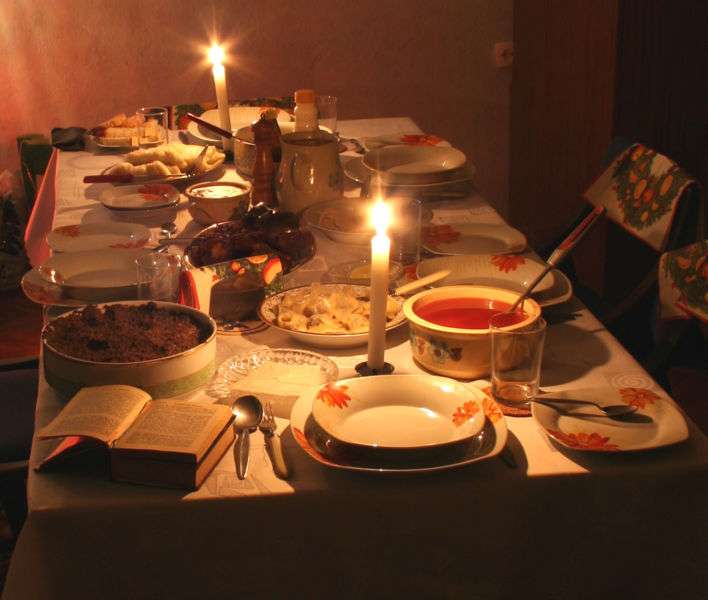
- The Christmas Eve supper is usually held in candle light, in the evening after the first star appears in the sky.
- The star symbolizes the birth of Jesus in Christian tradition.
- Sometimes the meal takes place outside under the starts.
- Hay may be spread on the floor to recreate the experience of that first Christmas Eve in Bethlehem.
- Foods are often chosen for their symbolic meaning.
"The thirteen desserts are the traditional dessert foods used in celebrating Christmas in the French region of Provence. The "big supper" (le gros souper) ends with a ritual 13 desserts, representing Jesus Christ and the 12 apostles. The desserts always number thirteen but the exact items vary by local or familial tradition. The food traditionally is set out Christmas Eve and remains on the table three days until December 27."
"In Czech Republic and Slovakia the meal features a fish soup and breaded roasted carp with potato salad. Italian Catholics eat seven types of seafood. In some parts of Eastern Europe such as Poland and Lithuania, a traditional meatless 12-dishes Christmas Eve Supper is served before opening gifts. Cubans, Dominicans, and Puerto Ricans serve roast pig (pernil)."
"A symbolic Christmas Eve meal used to be a common Eastern Orthodox tradition in the Russian Empire, but today it has become virtually extinct in Russia as a result of the official atheism of the former Soviet Union; though it continues to be popular in Ukraine."
"By the Christmas traditions of the Serbs, this festive meal is copious and diverse in foods, although it is prepared in accordance with the rules of fasting. Besides a round, unleavened loaf of bread and salt, which are necessary, this meal may comprise e.g. roast fish, cooked beans, sauerkraut, noodles with ground walnuts, honey, and wine."
"In France and some other French-speaking areas, a long family dinner, called a réveillon, is held on Christmas Eve. The name of this dinner is based on the word réveil (meaning "waking"), because participation involves staying awake until midnight and beyond. The food consumed at réveillons is generally of an exceptional or luxurious nature. For instance, appetizers may include lobster, oysters, escargots or foie gras, etc. One traditional dish is turkey with chestnuts. Réveillons in Québec will often include some variety of tourtière. Dessert may consist of a bûche de Noël. In Provence, the tradition of the 13 desserts is followed: 13 desserts are served, almost invariably including: pompe à l'huile (a flavoured bread), dates, etc. Quality wine is usually consumed a such dinners, often with champagne or similar sparkling wines as a conclusion."
"In Germany traditions vary from region to region. Carp is eaten in many parts of the country. Potato salad with frankfurter or wiener sausages is popular in some families. Another simple meal which some families favour, especially in regions where Christmas Eve still has the character of a fast day, is vegetable or pea soup. In some regions, especially in Schleswig-Holstein where Danish influence is noticeable, a roasted duck or goose filled with plums, apples and raisins is family tradition. In other regions, especially in Mecklenburg and Pomerania, many families prefer kale with boiled potatoes, special sausages and ham. Many families have developed new traditions for themselves and eat such meals as meat fondue or raclette. In almost all families in all parts of Germany you find a wide variety of Christmas cookies baked according to recipes typical for the family and the region."
A tweleve-dish Christmas Eve supper: (pictured at top) is traditionally prepared in Polish, Lithunian, and Ukrainian culture. The meal (Polish: Wigilia, Ukrainian: Свята вечеря, Sviata vecheria, Lithuanian: Kūčios) consists of twelve meatless dishes representing the twelve Apostles or twelve months of the year. The tradition of the supper can be traced back to pre-Christian times and connected with remembrance of the souls of deceased ancestors.
__________________________________________________________
Related Categories:
Christmas-linked holidays | December observances | June observances | Secular holidays | Winter festivals | Winter holidays