A Fun Party Food! by: Pam Svoboda
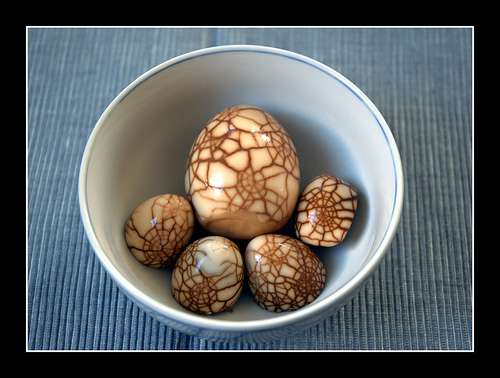
Tea eggs (also called marbled eggs) have to be one of the best conversation foods that anyone could ever put on a table. In Hong Kong, China and Taiwan they are common fair but in the United States you get a lot of "What is that" comments when you serve this food. This photo by chotda is a great example of brown tea eggs. Check out the wonderful spider-web looking lines on the eggs. This really adds a unique look to meal time wouldn't you say? In the United States, tea eggs are popular at Halloween parties because they can look really spooky when placed on a Halloween dinner table. Can't you just imagine creepy spiders walking all over these eggs? (Other spider favorites- spider dip bowl & wooly spider cupcakes- see Halloween recipes) This dish is also popular with Animal-Lovers and Rescue Communties that celebrate "National Save A Spider Day" This holiday is celebrated on March 14th each and every month.
"Regular Preparation" by: wikipedia
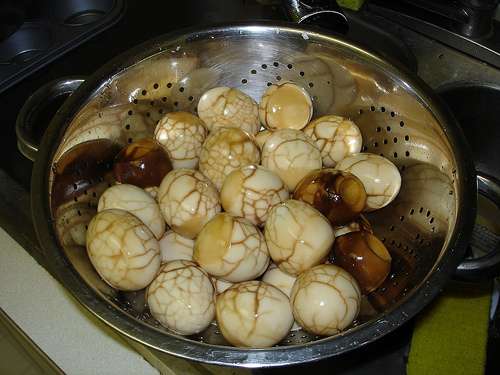
Tea eggs are simply hard-boiled eggs that have been further stewed in a salted tea liquid. Other flavourings such as soy sauce and Chinese five-spice powder are often added as well. The eggs are actually boiled twice. After the first boiling, when the insides are hardened, the shell of each egg is lightly cracked. The eggs are then boiled for much longer duration in the black tea mixture for a second time, which allows the flavour of the tea to penetrate deep into the egg. The dark colour of the tea also stains through the cracks of the eggs creating a pattern on the peeled eggs that resembles the crazing of some ceramic glaze surfaces.
Quick Method
Another method used to make tea eggs is to simply take off the eggshell and boil it in the tea mixture, instead of leaving the cracked eggshell on. This method is not as attractive but it is quicker. Most people would only use this method in an informal setting, when they don't have much time. Some people simply just leave the egg (with its shell on) floating in the tea mixture several hours before planned, so the tea can be absorbed and later warmed by boiling the water on high heat when wanted to eat.
Appearance and Flavor
In the end, when the peel comes off, the egg should have regions of light and dark brown, with mid-brownish tone along the cracks of the shell. The yolk should have a thin greyish layer with the core being the usual yellow. As for flavor, it depends on which tea (the type and strength) and the variety of spices that are used. Five-spice powder adds a savory, slightly salty tone to the white, and the tea should bring out the yolk's flavor.
Hong Kong
The tea used in making tea eggs is usually low in quality but high in dark-brown tannins. Green tea is considered too bitter for the use of making tea eggs. In Hong Kong Pu-erh tea is most commonly used, but it can be substituted with black tea.
China
Tea egg is a typical Chinese savory snack commonly sold by street vendors or in night markets in most Chinese communities throughout the world.
In Northeast China tea eggs are often privately made and sold. One might also see street vendors cooking and selling steaming-hot tea eggs. In Shanghai, tea eggs are sold by both convenience stores and private street vendors, where the tea eggs are often cooked together with dried tofu.
Taiwan
In Taiwan, tea eggs are a fixture of convenience stores. Through 7-Eleven chains alone, an average of 40 million tea eggs are sold per year.
See deviled egg recipes:
___________________________________________________________
___________________________________________________________
Resource Links:
You may also want to research:
See also:
________________________________________________________________
Resource Links:
Dinner has always been associated with special occasions, with special moments, with persons who matter the most... Invite your friend, sweetheart, family or loved ones for dinner with these classy and warm Dinner Invitation ecards.