__________________________________________________________________________________________
Definition of Tea
"Tea refers to the agricultural products of the leaves, leaf buds, and internodes of Camellia sinensis, prepared and cured by various methods. "Tea" also refers to the aromatic beverage prepared from such cured leaves by combination with hot or boiling water and the colloquial name for the Camellia sinensis plant itself."
- "Tea is the most widely-consumed beverage after water. It has a cooling, slightly bitter, astringent flavor."
- The four types of tea most commonly found on the market are black tea, oolong tea, green tea and white tea, all of which can be made from the same bushes, processed differently, and in the case of fine white tea, grown differently. Pu-erh tea, a double-fermented black tea, is also often classified as among the most popular types of tea.
- "The term "herbal tea" usually refers to an infusion or tisane of fruit or herbs that contains no Camellia sinensis." "The term "red tea" either refers to an infusion made from the South African rooibos plant, also containing no Camellia sinensis, or, in Chinese and other East Asian languages, is a term for black tea."
_________________________________________________________________________________________
About Tea Leaves: by wikipedia encyclopedia
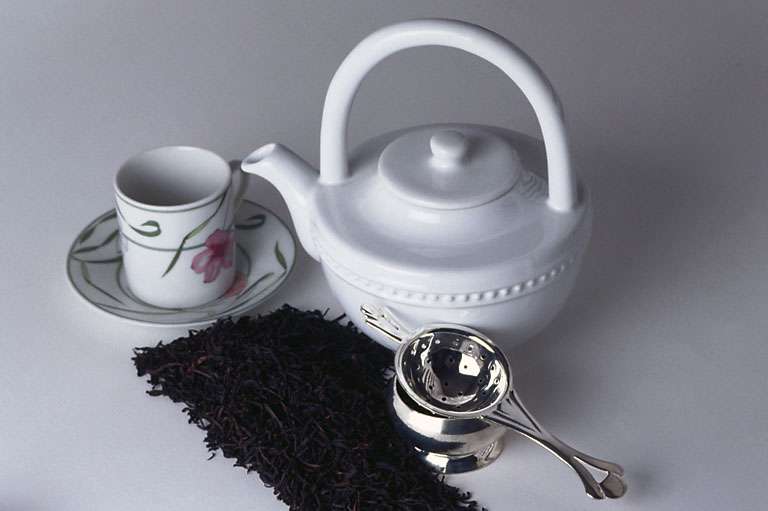
"The tea leaves are packaged loosely in a canister or other container." "Rolled gunpowder tea leaves, which resist crumbling, are commonly vacuum packed for freshness in aluminized packaging for storage and retail." "The portions must be individually measured by the consumer for use in a cup, mug, or teapot." "This allows greater flexibility, letting the consumer brew weaker or stronger tea as desired, but convenience is sacrificed."
"Strainers, "tea presses", filtered teapots, and infusion bags are available commercially to avoid having to drink the floating loose leaves and to prevent over-brewing." "A more traditional, yet perhaps more effective way around this problem is to use a three-piece lidded teacup, called a gaiwan." "The lid of the gaiwan can be tilted to decant the leaves while pouring the tea into a different cup for consumption."
Tea Storage
"Tea has a shelf life that varies with storage conditions and type of tea." "Black tea has a longer shelf life than green tea. Some teas such as flower teas may go bad in a month or so. An exception, Pu-erh tea improves with age." "Tea stays freshest when stored in a dry, cool, dark place in an air-tight container." "Black tea stored in a bag inside a sealed opaque canister may keep for two years." "Green tea loses its freshness more quickly, usually in less than a year. Gunpowder tea, its leaves being tightly rolled, keeps longer than the more open-leafed Chun Mee tea." "Storage life for all teas can be extended by using desiccant packets or oxygen absorbing packets, and by vacuum sealing."
"When storing green tea, discreet use of refrigeration or freezing is recommended. In particular, drinkers need to take precautions against temperature variation."
"Improperly stored tea may lose flavor, acquire disagreeable flavors or odors from other foods, or become moldy."
See also:
________________________________________________________________
Resource Links:
Dinner has always been associated with special occasions, with special moments, with persons who matter the most... Invite your friend, sweetheart, family or loved ones for dinner with these classy and warm Dinner Invitation ecards.