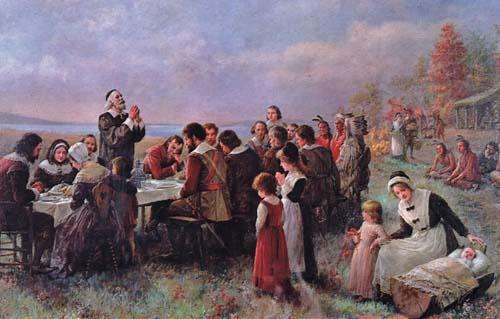
Thanksgiving Day in America is a time for family and friends to gather together and give thanks for all that God has given us.
Thanksgiving was originally a religious observance for all the members of the community to give thanks to God for a common purpose. Historic reasons for community thanksgivings include the 1541 thanksgiving mass after the expedition of Coronado safely crossing part of Texas and finding game, and the 1777 thanksgiving after the victory in the revolutionary battle of Saratoga etc. wikipedia
__________________________________________________________
Giving Thanks is an American Public Media radio special
that airs nationwide on Thanksgiving Day. It is hosted by John Birge. The show consists of classical music, songs, and dramatic readings all related to Thanksgiving. Although the format remains the same, some individual selections are always featured, notably Charles Laughton's monologue (featured in the out-of-print LP The Story Teller) about his experiences at Chartres Cathedral, as well as a selection from Jack Kerouac's The Dharma Bums also read by Laughton. Other selections regularly included are Handel's Largo from Xerxes and music from Aaron Copland's Appalachian Spring.
Although John Birge began doing an annual Thanksgiving program in 1985, Giving Thanks did not go national until 1999, two years after he began working for American Public Media. Birge states on the website for the program that Thanksgiving is his favorite holiday.
__________________________________________________________
Gratitude, appreciation, or thankfulness
is a positive emotion or attitude in acknowledgment of a benefit that one has received or will receive.
In a religious context, gratitude can also refer to a feeling of indebtedness towards a deity. Most religions prescribe rituals of thanksgiving towards their higher powers; the expression of gratitude to God is a central theme of Christianity and Islam.
In contrast to the positive feeling of gratitude, the feeling of indebtedness is a negative reaction to a favor (Tsang, 2006a; Watkins, Scheer, Ovnicek, & Kolts, 2006). Even though our reactions to favors might not always be positive, researchers have found that people express gratitude often. In a 1998 Gallup poll, the majority of Americans said they express gratitude to God (54%) and others (67%) "all the time."
Psychological research has demonstrated that individuals are more likely to experience gratitude when they receive a favor that is perceived to be (1) valued by the recipient, (2) costly to the benefactor, (3) given by the benefactor with benevolent intentions, and (4) given gratuitously (rather than out of role-based obligations) (e.g., Bar-Tal, Bar-Zohar, Greenberg, & Hermon, 1977; Graham, 1988; Lane & Anderson, 1976; Tesser, Gatewood, & Driver, 1968). Individuals who are induced to feel grateful are more likely to behave prosocially toward their benefactor (Tsang, 2006b) or toward unrelated others (Bartlett & DeSteno, 2006).
__________________________________________________
How can I Celebrate this holiday?
- Blog with us about it! - We have a blog called "Everyday is a Holiday" so visit our pages and talk with us about this holiday.
- Send Free E-Greeting! - If your ready to get together with your friends don't forget to invite them with these fun Internet Invitations.
___________________________________________________
Other November Holidays around the world
______________________________________________
You may also be interested in these related pages: