When is this holiday celebrated?
This holiday is observed & celebrated on December 6 every year, which is the main "Feast Day." (Greece)
(05 December in the Netherlands, 06 December in Belgium)
__________________________________________________________
What is this holiday about?
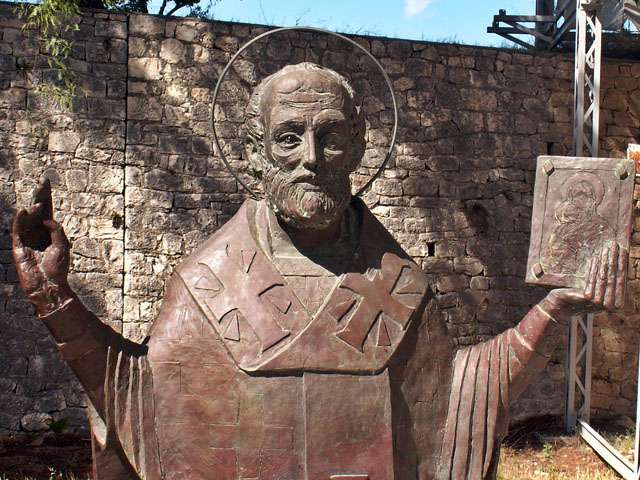
It's all about honoring the real Saint Nicholas- which is also spelled Nicolas or Nikolas - (who is now commonly identified with Santa Claus)
__________________________________________________________
Saint Nicholas Day Celebrated
In late medieval England, on Saint Nicholas' Day parishes held Yuletide "boy bishop" celebrations. As part of this celebration, youths performed the functions of priests and bishops, and exercised rule over their elders. Today, Saint Nicholas is still celebrated as a great gift-giver in several Western European countries. According to one source, medieval nuns used the night of December 6th to anonymously deposit baskets of food and clothes at the doorsteps of the needy. According to another source, on December 6th every sailor or ex-sailor of the Low Countries (which at that time was virtually all of the male population) would descend to the harbour towns to participate in a church celebration for their patron saint. On the way back they would stop at one of the various Nicholas fairs to buy some hard-to-come-by goods, gifts for their loved ones and invariably some little presents for their children. While the real gifts would only be presented at Christmas, the little presents for the children were given right away, courtesy of Saint Nicholas. This and his miracle of him resurrecting the three butchered children, made Saint Nicholas a patron saint of children and later students as well.
Among Albanians, Saint Nicholas is known as Shen'Kollë and is venerated by most Catholic families, even those from villages that are devoted to other saints. The Feast of Saint Nicholas is celebrated on the eve of December 5th, known as Shen'Kolli i Dimnit (Saint Nicholas of Winter), as well as on the commemoration of the interring of his bones in Bari, the eve of May 8th, known as Shen'Kolli i Majit (Saint Nicholas of May). Albanian Catholics often swear by Saint Nicholas, saying "Pasha Shejnti Shen'Kollin!" ("May I see Holy Saint Nicholas!"), indicting the importance of this saint in Albanian culture, especially among the Albanians of Malësia. On the eve of his feast day, Albanians will light a candle and abstain from meat, preparing a feast of roasted lamb and pork, to be served to guests after midnight. Guests will greet each other, saying, "Nata e Shen'Kollit ju nihmoftë!" ("May the Night of Saint Nicholas help you!") and other such blessings. The bones of Albania's greatest hero, Gjergj Kastrioti, were also interred in the Church of Saint Nicholas in Lezha, Albania, upon his death. So strong and powerful was the mystery surrounding this figure and this holy church, that the invading Turks stole the bones and used them as amulets, so they are no longer there.
__________________________________________________________
Who was Saint Nicholas?
Saint Nicholas (Greek: Άγιος Νικόλαος , Agios Nikolaos, "victory of the people") is the common name for Nicholas of Myra, a Christian saint and Bishop of Myra in Lycia of Anatolia (modern-day Antalya province, Turkey, though at the time it was a Greek-speaking Roman Province). Because of the many miracles attributed to his intercessions, he is also known as Saint Nicholas the Wonderworker. He had a reputation for secret gift-giving, such as putting coins in the shoes of those who left them out for him, and is now commonly identified with Santa Claus. Nicholas was never officially canonised; his reputation simply evolved among the faithful, as was the custom in his time. In 1087, his relics were furtively translated to Bari in southern Italy. For this reason, he is also known as Saint Nicholas of Bari.
The historical Saint Nicholas is remembered and revered among Catholic and Orthodox Christians. He is also honoured by various Anglican and Lutheran churches. Saint Nicholas is the patron saint of sailors, merchants, archers, children, and students in Greece, Belgium, Romania, Bulgaria, Georgia, Russia, the Republic of Macedonia, Slovakia, Serbia and Montenegro. He is also the patron saint of Barranquilla (Colombia), Bari (Italy), Amsterdam (Netherlands), Beit Jala in the West Bank of Palestine and Russia. In 1809, the New-York Historical Society convened and retroactively named Sancte Claus the patron saint of Nieuw Amsterdam, the Dutch name for New York City. He was also a patron of the Varangian Guard of the Eastern Roman Emperors, who protected his relics in Bari. So beloved is St. Nicholas by Russians, one commonly heard saying is "if God dies, at least we'll still have St. Nicholas." /documentation_license
__________________________________________________________
What type of holiday is this?
__________________________________________________________
Other December Holidays around the world
_________________________________________________
You may be interested in these related pages