_____________________________________________________
Church tradition
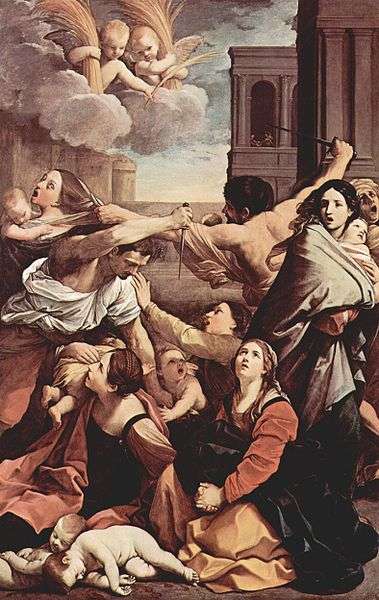
"According to Matthew, when the Magi (popularly known as the "Three Wise Men") sought out the birth of Jesus, they first visited Herod the Great to ask, "where is He that is born King of the Jews". "Herod, the Roman client king in Judea, feeling that his throne was in jeopardy, asked the Magi to find the child and return to tell him so that he may worship him, with the hidden intention of killing the identified child immediately." "When the Magi, warned in dreams of the king's true intentions, returned home by a different route to avoid being forced to betray the child, Herod ordered the slaughter of all male children who were two years old and under." "Fortunately for them, according to Matthew, Joseph, Mary and Jesus had fled to Egypt after they had been warned by an angel. Jesus thus avoided being killed."
"The passage specifically describes this event as happening in Bethlehem, which would probably have been a small village, and the surrounding rural areas." "The Byzantine liturgy had 14,000 Holy Innocents and an early Syrian list of saints states that there were 64,000." "The Catholic Encyclopedia in 1910 suggested that these numbers were probably inflated, and that for a town of that size probably only between six and twenty children would be killed, with a dozen or so more in the surrounding areas."
"According to the gospel of Matthew, the massacre fulfilled a verse of Jeremiah (31:15), interpreted by Christians as a prophecy of this event: "Thus says the Lord: A voice is heard in Ramah, lamentation and bitter weeping." "Rachel is weeping for her children." The narrative of Matthew connects a series of interpreted prophesies, drawn from Hebrew bible texts."
"Jews do not interpret the quotation as a prophecy at all, but as a poetic description of the Babylonian exile." "This is reflected in the next verse, Jeremiah 31:16, in which God asks "Rachel" to stop crying, because her children "shall come again from the land of the enemy." According to some interpreters,[who?] this is actually the purpose of Matthew for including Jeremiah's words: he does not mean to connect the reference to "weeping" with the slaughtered Bethlehemite babies, but with the infant Jesus, who has gone to a foreign land, as the people of Israel had done before him. However, he is going to be led back by God (31:16)." "Although the quotation in Matthew is from Jeremiah, the Old Syriac Codex Sinaiticus referred to Isaiah. Some textual critics conclude that the mistake occurred in the original manuscript, and was corrected in later copies."
_____________________________________________________________
Other December Holidays around the world
_________________________________________________
How can I Celebrate this holiday?
- It's Party Time! - Every Holiday deserves a party right?! So get ready for your next party by shopping for the lastest supplies to make your holday a real hit. You'll find fun stuff for children and adults.
- Send Free Internet Invitations! - If your ready to get together with your friends don't forget to invite them by email with these fun Internet Invitations. They are always fun & FREE!
- Blog with us about it! - We have a blog called "Everyday is a Holiday" so visit our pages and talk with us about this holiday and how you celebrated it. We would love to know.
___________________________________________________
When is this holiday celebrated?
Holy Innocents Day is celebrated annually on December 28 every year.
Massacre of the Innocents?
"The Massacre of the Innocents is an episode of infanticide by Herod the Great that appears in the Gospel of Matthew (Matthew 2:16-18)." "It is not mentioned in the other gospels, nor does it figure in the early apocrypha, with the exception of the Protoevangelium of James 22." "Matthew relates that King Herod ordered the execution of all young male children in the village of Bethlehem, so as to avoid the loss of his throne to a newborn "King of the Jews" whose birth had been announced to him by the Magi."
"Most modern biographers of Herod do not regard the massacre as an actual historical event. Many scholars portray this and other nativity stories as creative hagiography rather than history."